Introduction
Search is changing.
People are no longer using search engines only to find a list of websites. Increasingly, they are asking complete questions and expecting an immediate, synthesized answer.
Google Search can provide AI-generated responses through features such as AI Overviews and AI Mode, while Microsoft is expanding AI-generated experiences across Bing and Copilot. These experiences can use information from multiple web sources and provide links or citations to supporting pages.
This creates a new opportunity for businesses, publishers, and marketers.
Instead of optimizing only for traditional rankings, brands now need to make their content easy for search engines and AI systems to understand, verify, extract, and cite.
That is where modern approaches such as AI search optimization, Answer Engine Optimization (AEO), and Generative Engine Optimization (GEO) become important.
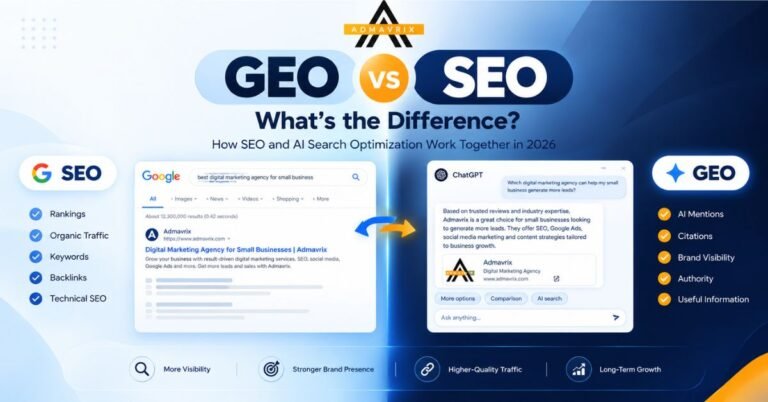
But there is a common misconception: optimizing for AI search does not mean abandoning traditional SEO.
Google’s current guidance specifically states that SEO best practices remain relevant for its generative AI search experiences because these features are built on Google’s existing Search systems.
So, what should businesses actually do?
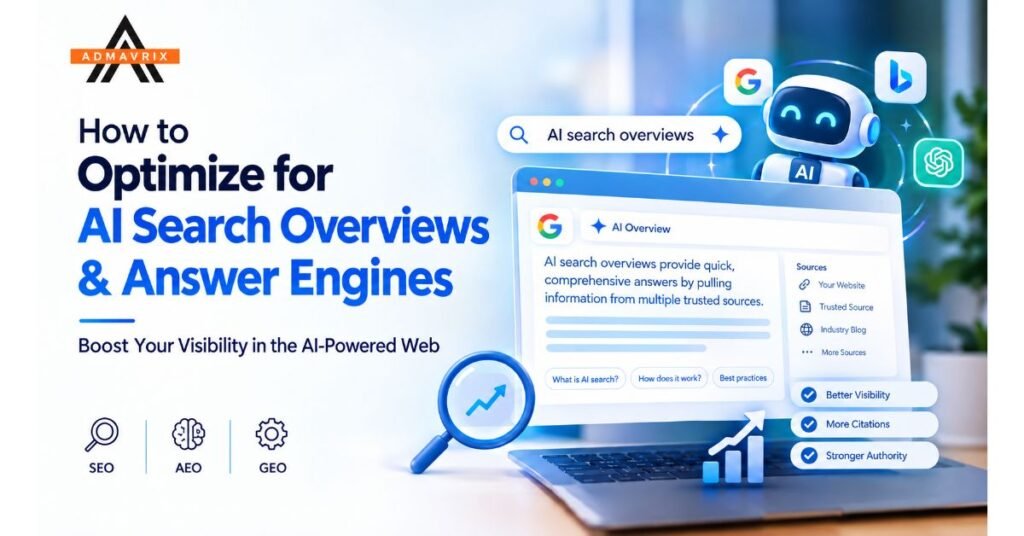
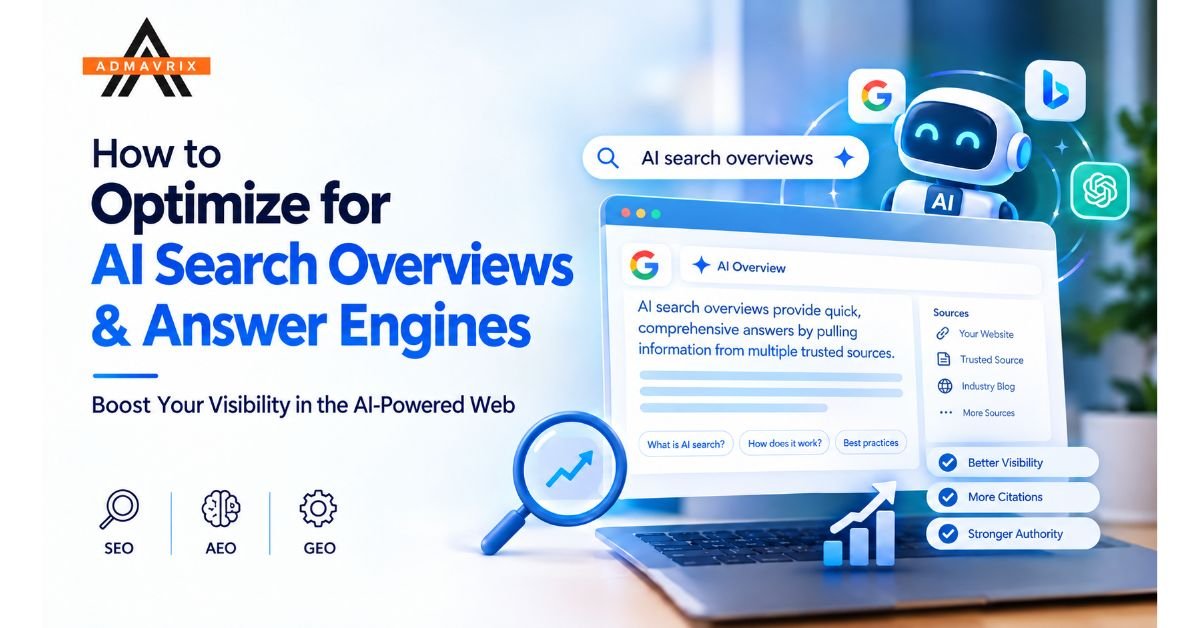
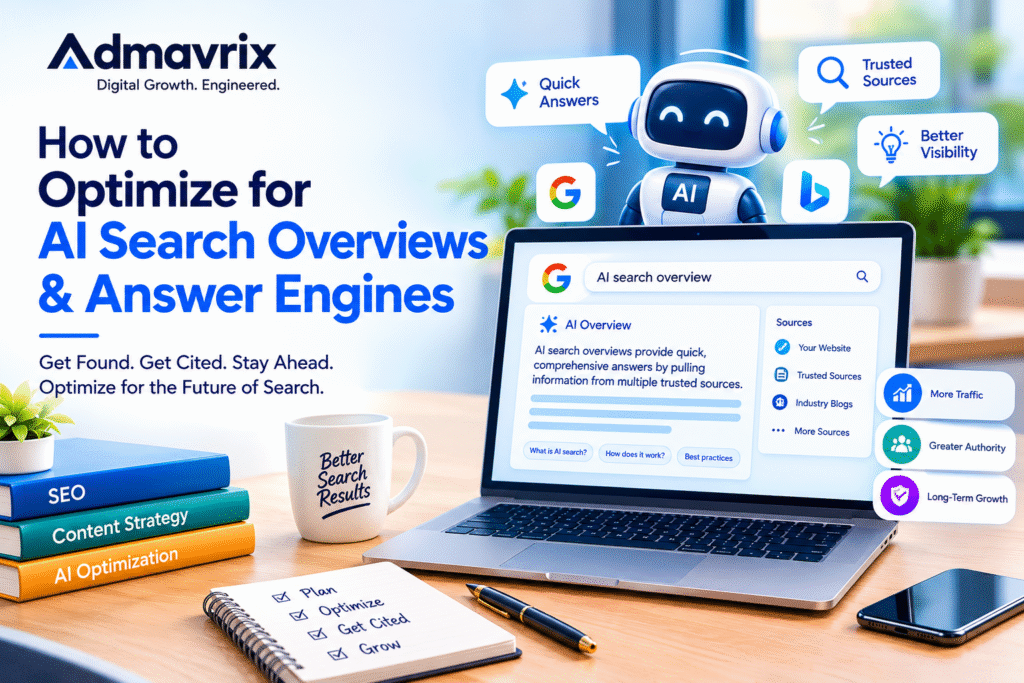
Let’s explore a practical framework for how to optimize for AI Search Overviews and answer engines in 2026.
Meaning: What Is AI Search Optimization?
AI search optimization is the process of creating and structuring website content so that search engines and AI-powered search systems can understand the content, identify its relevance, and potentially use it when generating answers.
Traditional SEO often focuses on questions such as:
- What keyword should this page rank for?
- How can we improve organic rankings?
- How can we earn backlinks?
- How can we increase clicks from search results?
AI search adds additional questions:
- Can an AI system clearly understand this page?
- Does the page directly answer the user’s question?
- Is the information supported by credible evidence?
- Can important facts be easily extracted?
- Does the content provide original information or analysis?
- Is the page useful enough to be cited as a source?
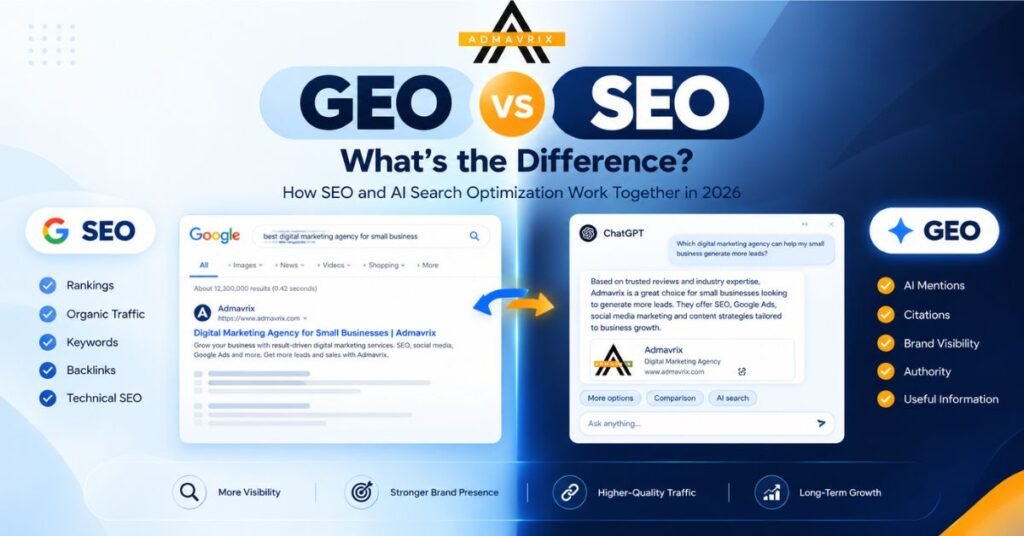
Microsoft describes this broader shift as Generative Engine Optimization, where visibility increasingly involves how content contributes to AI answers, citations, and outcomes.
Key Points
A strong AI search optimization strategy should focus on:
- Search intent
- Clear answers
- Topical depth
- Original information
- Credible sources
- Structured content
- Technical SEO
- Internal linking
- Entity clarity
- Fresh and accurate information
- Multimedia consistency
- Human-first content
The goal is not to write content that sounds like it was created for an AI.
The goal is to create content that is so clear, useful, specific, and trustworthy that both people and search systems can understand it easily.
Visual Introduction: Traditional Search vs AI Search
Think of the difference this way:
Traditional Search
User → Search Query → Search Results → Website → Answer
AI-Powered Search
User → Question → Search/AI System → Multiple Sources → Synthesized Answer → Citations → Website
This means your website can potentially be valuable even when the user does not interact with the search results in exactly the same way as before.
Your content can become a source used to construct an answer.
What Are AI Overviews and Answer Engines?
AI Overviews
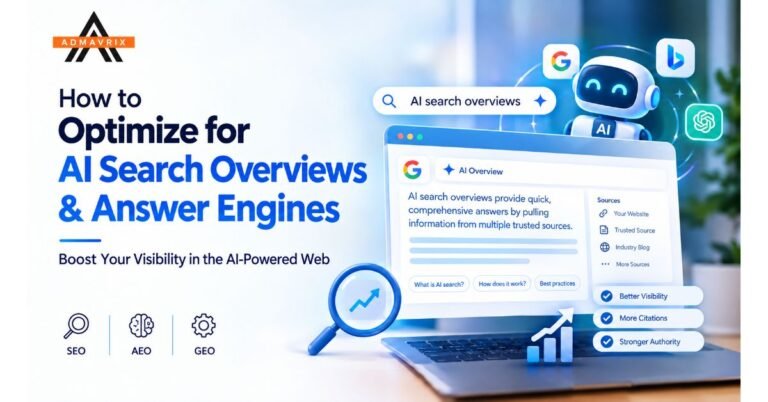
AI Overviews are AI-generated summaries that can appear within Google Search for eligible queries.
Instead of showing only traditional links, Google’s AI features can synthesize information from multiple sources and provide links for users who want to explore further.
Google’s documentation explains that AI Overviews and AI Mode can use web sources as part of their responses.
Answer Engines
An answer engine is a search or AI system designed to provide a direct answer to a user’s question instead of simply returning a traditional list of webpages.
Examples of AI-powered answer experiences include:
- Google AI Overviews
- Google AI Mode
- Microsoft Copilot
- Bing AI-generated experiences
- Other AI assistants and search interfaces
The exact way these systems select and display sources can change over time.
Therefore, businesses should avoid relying on a single platform-specific trick.
Instead, build content around strong information architecture, search intent, credibility, technical accessibility, and useful original information.
Features of AI-Optimized Content
Good content for AI search generally has several characteristics.
1. Direct answers
Answer the primary question quickly.
Do not make readers scroll through 1,000 words before they discover the basic definition.
For example:
Question: What is Answer Engine Optimization?
Weak approach:
Start with five paragraphs about the history of digital marketing.
Better approach:
Answer the definition in two or three sentences and then expand with examples, benefits, and implementation steps.
2. Clear headings
Use descriptive headings such as:
- What Is AI Search Optimization?
- Why Does AI Search Matter?
- How to Optimize Content for AI Search
- Common AI SEO Mistakes
- AI Search Optimization Checklist
Clear headings help users scan the page and help search systems understand the relationship between sections.
3. Structured information
Use:
- Tables
- Lists
- Step-by-step instructions
- Definitions
- Examples
- FAQs
- Comparisons
- Statistics
- Supporting evidence
Structured content is easier for humans to navigate and easier for systems to interpret.
4. Original value
Do not simply rewrite what ten other websites already say.
Add:
- Original examples
- First-hand observations
- Unique data
- Expert commentary
- Screenshots
- Calculations
- Case studies
- Industry-specific insights
Google’s 2026 guidance emphasizes providing non-commodity content for generative AI search experiences.
Benefits of Optimizing for AI Search
1. Greater visibility
Your content can have opportunities to appear in traditional search as well as AI-powered search experiences.
2. More brand exposure
Even when a user does not immediately click, being referenced as a source can increase brand visibility.
3. Stronger topical authority
Building comprehensive content around a subject can help establish your website as a useful resource.
4. Better user experience
Many AI-search optimization practices are simply good content practices:
- Clear answers
- Better structure
- Accurate information
- Helpful examples
- Strong navigation
5. Future-ready SEO
Search behavior is evolving.
Optimizing for AI search allows businesses to prepare for search experiences where answers, citations, conversations, and actions increasingly work together.
Quick Insights Table
| SEO Element | Traditional SEO | AI Search Optimization |
|---|---|---|
| Main goal | Improve rankings and clicks | Improve visibility, relevance and potential citation |
| Keywords | Important | Important, but intent and context matter more |
| Content | Relevant information | Clear, comprehensive and useful information |
| Structure | Headings and formatting | Highly structured, answer-friendly content |
| Authority | Backlinks, reputation | Authority, evidence, sources and original value |
| User intent | Important | Critical |
| FAQs | Useful | Useful for addressing related questions |
| Internal links | Important | Important for context and discovery |
| Freshness | Important for changing topics | Particularly important for current information |
| AI visibility | Secondary | Increasingly important |
| Measurement | Rankings, clicks, impressions | Rankings, clicks, citations and AI visibility signals |
Small Case Study: How an Agency Could Optimize Its Content
Imagine a digital marketing agency publishes an article called:
“What Is Digital Marketing?”
The article explains digital marketing in 2,000 words but contains mostly generic definitions.
It may be difficult to differentiate from thousands of similar pages.
Now imagine the agency creates a more useful resource:
“Digital Marketing Strategy for Small Businesses: SEO, Google Ads, Social Media and Analytics”
The article includes:
- A direct definition
- A strategy framework
- Channel-by-channel explanations
- Budget examples
- Common mistakes
- A comparison table
- Real campaign considerations
- Original examples
- Expert commentary
- FAQs
- Internal links to related services
The second article gives search systems more meaningful information to understand and potentially reference.
The lesson is simple:
Do not optimize only for a keyword. Optimize for the complete information need behind the keyword.
Deep Explanation: How to Optimize for AI Search Overviews & Answer Engines
Step 1: Understand the Search Intent
Before writing anything, identify what the user actually wants.
Search intent commonly includes:
Informational
The user wants to learn.
Examples:
- What is SEO?
- What is GEO?
- How does Google Ads work?
Commercial Investigation
The user is comparing options.
Examples:
- SEO vs Google Ads
- Best digital marketing agency
- Meta Ads vs Google Ads
Transactional
The user wants to take an action.
Examples:
- Hire SEO agency
- Buy SEO software
- Book digital marketing consultation
Navigational
The user wants a specific website or brand.
Examples:
- Admavrix
- Google Search Console login
- Meta Ads Manager
AI search systems are increasingly designed to understand natural-language questions, so writing around intent and context is more useful than repeating an exact keyword.
Step 2: Build Content Around Questions
Instead of targeting only:
AI SEO
build a topic cluster around related questions:
- What is AI SEO?
- How does AI search work?
- What are AI Overviews?
- How do AI Overviews choose sources?
- What is Answer Engine Optimization?
- What is Generative Engine Optimization?
- How do I optimize content for AI search?
- Does traditional SEO still matter for AI search?
- How can I measure AI visibility?
This creates topical depth.
Step 3: Give the Direct Answer First
Use the Answer First → Explanation → Evidence → Example framework.
For example:
What is Answer Engine Optimization?
Answer Engine Optimization is the practice of structuring and improving content so that answer-focused search systems can understand, retrieve, and potentially reference the information when responding to user questions.
Then explain:
- How it works
- Why it matters
- How to implement it
- Examples
- Limitations
This format helps both readers and search systems.
Step 4: Use Clear Content Architecture
A strong article structure can look like:
H1: Main topic
H2: Definition
H2: Why it matters
H2: How it works
H2: Benefits
H2: Step-by-step strategy
H3: Individual tactics
H2: Examples
H2: Common mistakes
H2: FAQs
H2: Conclusion
This creates a logical information hierarchy.
Step 5: Add Supporting Evidence
AI systems need reliable information to generate useful answers.
Support important claims with:
- Government sources
- Official documentation
- Research
- Industry reports
- First-party data
- Recognized experts
- Original company data
For example, Google Search Central is a better primary source for explaining Google’s own AI Search documentation than an anonymous SEO blog.
Google also recommends making content accessible to search crawlers and following its Search Essentials and spam policies.
Step 6: Make Your Content Easy to Verify
Avoid vague statements such as:
“AI search will completely replace Google.”
Instead write:
“AI-powered search is changing how information can be presented, while traditional search results remain part of the search ecosystem.”
This is more precise and defensible.
For changing topics, include:
- Publication date
- Updated date when appropriate
- Sources
- Author information
- Relevant references
Step 7: Strengthen E-E-A-T Signals
Focus on:
Experience
Show real experience where appropriate.
Expertise
Demonstrate subject knowledge.
Authoritativeness
Build a credible website and reputation.
Trust
Use accurate information, transparent sources, and clear business details.
Do not create fake expertise.
For example, instead of saying:
“We are the world’s leading AI SEO experts.”
Show expertise through:
- Real examples
- Original research
- Campaign insights
- Author credentials
- Practical frameworks
- Transparent methodology
Step 8: Create Strong Internal Links
Internal linking helps users and search engines discover related content.
For an Admavrix website, an article about AI search could link naturally to relevant pages about:
- SEO services
- Google Ads
- Social media marketing
- Content marketing
- Digital marketing strategy
- Analytics
- Digital marketing courses
Use descriptive anchor text rather than repeatedly using:
“Click here.”
For example:
Learn more about Admavrix SEO services is more descriptive than Click here.
Step 9: Use Structured Data Correctly
Structured data helps search engines understand specific information on a webpage.
Google’s Search Central documentation explains that structured data can help Google understand page content and can support certain search features.
Use appropriate structured data when it genuinely applies.
Examples include:
- Article
- Organization
- Breadcrumb
- LocalBusiness
- Product
- Course
- Event
Do not add structured data simply to manipulate search results.
The markup should accurately represent the visible content.
Step 10: Optimize Images and Multimedia
AI search is not only about text.
Google’s current AI optimization guidance includes consideration for local, shopping, image, and video content.
For every important image:
- Use descriptive filenames
- Add useful alt text
- Compress images
- Maintain good quality
- Use relevant captions when helpful
- Keep image context aligned with the page
Example filename:
ai-search-optimization-guide.jpg
Better than:
IMG_84920.jpg
Step 11: Keep Information Fresh
AI search needs current information, particularly for subjects that change frequently.
Review content when there are major changes involving:
- Google Search
- AI Overviews
- AI Mode
- Bing
- Search algorithms
- SEO guidelines
- Advertising platforms
- Technology
- Regulations
Do not change the publication date simply to make an old article appear new.
Update the actual information.
Google’s documentation is actively changing as its AI search features evolve; for example, Google added a dedicated generative-AI optimization guide in 2026.
Real Example: Google and Bing AI Search
Google’s current documentation says its generative AI search features continue to rely on the underlying Search systems and that established SEO practices remain relevant.
Microsoft has also introduced AI Performance in Bing Webmaster Tools, allowing publishers to see when their content is cited in AI-generated answers across Microsoft Copilot, Bing AI-generated summaries, and selected partner integrations.
This illustrates an important shift:
Search visibility is becoming broader than traditional ranking position alone.
A modern SEO strategy should therefore monitor both traditional search performance and emerging AI visibility signals where data is available.
Trends in AI Search Optimization
1. Search Is Becoming More Conversational
Users can ask longer and more natural questions.
Instead of:
SEO services
they may ask:
“How can a small business increase Google visibility without spending a huge amount on advertising?”
Content should address the underlying problem.
2. Citations Matter
AI systems can reference sources in generated answers.
Microsoft’s AI Performance reporting specifically focuses on citations and referenced URLs.
This makes credible, useful source material increasingly important.
3. Original Content Is Becoming More Valuable
Generic content is easy to reproduce.
Original research, examples, experiences, data, and insights give your page a stronger reason to exist.
4. Multimedia Is Becoming More Important
Modern search experiences can incorporate:
- Text
- Images
- Video
- Local information
- Products
- Other structured information
Google’s current AI search guidance specifically discusses different content formats and AI search visibility.
5. AI Visibility Measurement Is Developing
Traditional SEO has established metrics such as:
- Impressions
- Clicks
- CTR
- Rankings
- Organic traffic
AI search adds emerging signals such as:
- Citations
- Referenced URLs
- AI answer visibility
Microsoft’s AI Performance dashboard is an example of this evolution.
Common Mistakes
1: Keyword Stuffing
Repeating:
AI search optimization AI search optimization AI search optimization
does not create better content.
Use the topic naturally.
2: Writing Only for AI
Content should still be written for people.
Google’s guidance continues to emphasize useful, people-first content and established SEO practices.
3: Copying Competitors
If ten competitors already explain the same thing, producing the eleventh version without additional value will not differentiate your website.
4: Publishing AI-Generated Content Without Review
AI can help with:
- Research organization
- Outlines
- Brainstorming
- Editing
But blindly publishing generated information can introduce:
- Incorrect claims
- Outdated information
- Missing sources
- Repetitive writing
- Unsupported statistics
Always review important claims.
5: Ignoring Technical SEO
A great article cannot perform well if search engines cannot properly access, crawl, or understand the page.
Check:
- Indexability
- Robots directives
- Canonicals
- Page speed
- Mobile usability
- Internal links
- XML sitemap
- HTTPS
- Structured data
6: Creating Fake Statistics or Expert Quotes
Never create a statistic or quote simply because it makes an article look authoritative.
Use verified sources or clearly label original analysis.
7: Treating GEO as a Magic Trick
There is no single guaranteed “GEO hack” that forces AI systems to cite a website.
AI search systems are continuously evolving.
Focus on fundamentals rather than promises of guaranteed AI citations.
Pro Tips for AI Search Optimization
1: Answer the main question within the first few paragraphs.
2: Use question-based H2 and H3 headings where appropriate.
3: Add concise definitions before deep explanations.
4: Use tables for comparisons and structured information.
5: Add original examples instead of generic filler.
6: Cite important factual claims.
7: Build topic clusters instead of isolated articles.
8: Improve internal linking.
9: Keep important information updated.
10: Make author and business information transparent.
11: Use descriptive image filenames and alt text.
12: Track both organic SEO and emerging AI visibility signals.
Expert Quotes and Guidance
Google Search Central’s current guidance makes an important point: traditional SEO remains relevant for generative AI search because Google’s AI features are built on its existing Search systems.
Microsoft’s Jordi Ribas has described the evolution of search as a move toward systems where content contributes not only to rankings but also to answers, citations, and outcomes.
These official perspectives support a practical conclusion:
AI search optimization is not a replacement for SEO. It is an expansion of how SEO needs to think about visibility.
Step-by-Step Guide: AI Search Optimization Checklist
Use this checklist when publishing a new article.
1: Choose the primary topic
Identify the main question your audience wants answered.
2: Define the focus keyword
Choose one primary keyword that matches the page’s intent.
3: Research related questions
Find related questions, subtopics, entities, and terminology.
4: Build the outline
Create a logical structure using H2 and H3 headings.
5: Answer first
Give the reader a concise answer before going deeper.
6: Add depth
Include examples, explanations, comparisons, data, and practical advice.
7: Add original value
Include something competitors do not provide.
8: Add trustworthy sources
Support important factual statements with reliable references.
9: Optimize the page
Check:
- Title
- URL
- Meta description
- Headings
- Focus keyword
- Images
- Alt text
- Internal links
- External links
- Schema
- Mobile experience
10: Improve readability
Use short paragraphs, lists, tables, and clear headings.
11: Check technical SEO
Make sure the page can be crawled and indexed correctly.
12: Publish and monitor
Use Google Search Console and other available webmaster tools to monitor performance.
For Bing, AI Performance can provide information about citations in supported AI-generated experiences.
13: Update the content
Revisit the article when the topic changes significantly.
FAQ Section
What is AI search optimization?
AI search optimization is the process of improving website content so that AI-powered search systems can understand, evaluate, and potentially reference it when generating answers.
What are AI Overviews?
AI Overviews are AI-generated responses that can appear within Google Search for eligible queries, synthesizing information from sources and providing links for further exploration.
What is Answer Engine Optimization?
Answer Engine Optimization, or AEO, focuses on making content useful and understandable for systems that provide direct answers to user questions.
What is Generative Engine Optimization?
Generative Engine Optimization, or GEO, is a broader approach to improving how content participates in generative AI experiences, including potential visibility, references, and citations.
Does traditional SEO still matter for AI search?
Yes. Google states that its generative AI search features are based on its existing Search systems, meaning established SEO practices remain relevant.
Can I guarantee that Google AI Overviews will cite my website?
No. There is no reliable method that guarantees a particular website will be selected as a source for an AI-generated answer.
Does keyword stuffing help with AI search?
No. Keyword stuffing can make content less useful and less natural. Focus on topic coverage, intent, clarity, and useful information.
Should I use AI to write SEO content?
AI can assist with research, outlines, brainstorming, and editing, but human review is important for accuracy, originality, experience, and quality.
Are backlinks still important?
Links remain part of the broader web ecosystem, but AI search optimization should not be reduced to backlink quantity. Focus on earning relevant, trustworthy references and creating genuinely useful content.
Is GEO replacing SEO?
No. GEO is better understood as an emerging layer of optimization for generative search experiences. Traditional technical SEO, content quality, crawlability, relevance, and user experience remain important.
Future Outlook
The future of search is likely to become increasingly conversational and multimodal.
Users may move between:
- Search results
- AI-generated answers
- Voice interfaces
- Chat-based search
- Images
- Videos
- Shopping experiences
- Local results
- AI agents
For marketers, this means the definition of “ranking” may continue to expand.
The winning strategy is unlikely to be a single technical trick.
Instead, businesses should build a strong digital information ecosystem:
Useful Content + Technical SEO + Authority + Original Information + Structured Data + Strong Brand Signals + Fresh Information
Google and Microsoft are already developing tools and documentation around AI-generated search visibility. Google’s Search documentation now includes dedicated guidance for generative AI search, while Microsoft’s AI Performance tools provide publishers with visibility into citations across supported AI experiences.
The brands that consistently provide clear, trustworthy, original information will be better positioned to participate in this evolving search environment.
Conclusion
How to optimize for AI Search Overviews and answer engines is not about finding a secret formula to make an AI mention your website.
It is about creating content that deserves to be discovered, understood, trusted, and referenced.
Start with traditional SEO fundamentals.
Then strengthen your strategy with:
- Search-intent research
- Direct answers
- Clear content structure
- Original insights
- Reliable sources
- Strong internal linking
- Technical SEO
- Structured data
- Multimedia
- Fresh information
- Human review
- AI visibility monitoring
AI is changing how people discover information, but the fundamental principle remains the same:
Create useful content for real people, make it easy for search systems to understand, and give your audience a reason to trust your brand.
How Admavrix Can Help
At Admavrix, we combine SEO, content strategy, digital marketing, paid advertising, social media, analytics, and AI-powered marketing approaches to help businesses build stronger online visibility.
If your website is still optimized only for traditional search rankings, it may be time to look at the bigger picture.
Want to make your website more visible across modern search experiences?
DM us to discuss your SEO and AI search strategy.
Visit https://www.admavrix.com to learn more about Admavrix digital marketing services.