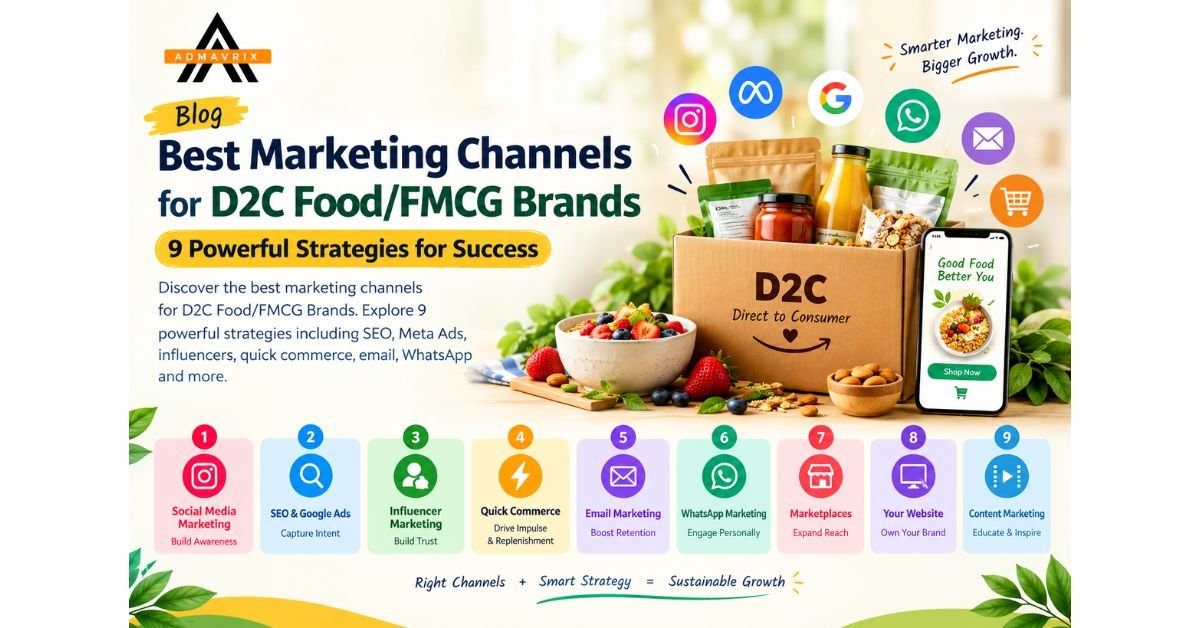
Introduction
Launching a D2C food or FMCG brand has never been more exciting—or more competitive.
Consumers can discover a new snack, beverage, condiment, health food or household product through Instagram in the morning, search for it on Google in the afternoon, see it on a quick-commerce app in the evening and purchase it within minutes.
That means today’s D2C brands cannot depend on a single marketing channel.
A successful strategy connects discovery, consideration, conversion and retention across multiple touchpoints.
For example, social media can create product awareness, creators can build trust, Google can capture purchase intent, the brand website can convert customers, and email or WhatsApp can encourage repeat purchases.
Quick commerce has also become increasingly important for food and FMCG brands in India. Recent industry reporting shows platforms such as Blinkit, Zepto and Swiggy Instamart are developing significant advertising businesses around high-intent shopping moments.
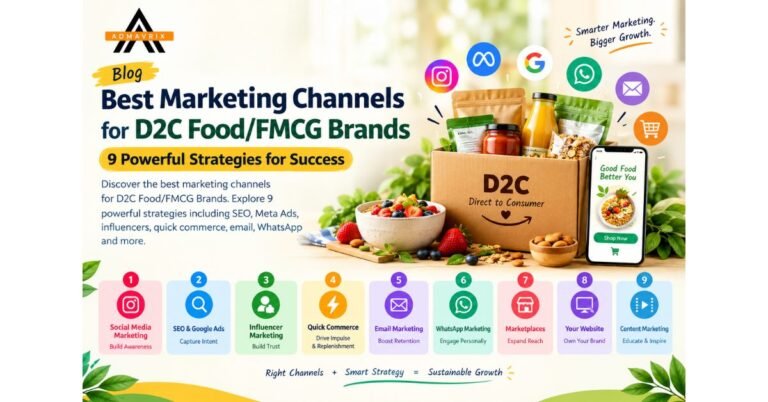
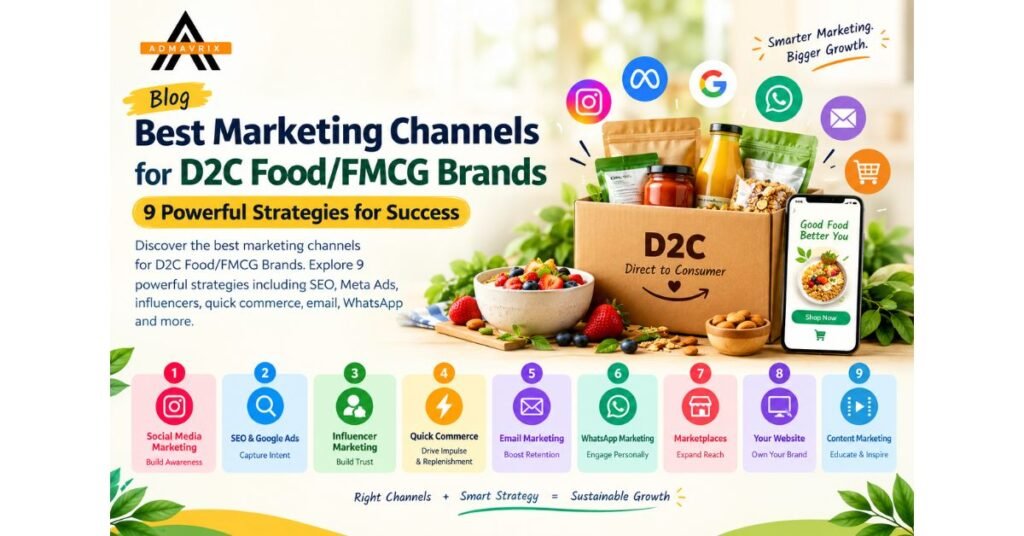
So, what are the best marketing channels for D2C Food/FMCG Brands?
Let’s explore the channels, their roles, benefits, limitations and how to combine them into one practical growth strategy.
Meaning: What Is D2C Food/FMCG Marketing?
D2C, or Direct-to-Consumer marketing, is a business model in which brands sell directly to customers rather than relying entirely on traditional distributors, wholesalers or retailers.
For a food or FMCG brand, D2C marketing can involve:
- Brand websites
- Social media
- Search engines
- Paid advertising
- Influencer marketing
- Email marketing
- WhatsApp marketing
- Marketplaces
- Quick-commerce platforms
- Affiliate marketing
- Content marketing
The important point is that these channels should not operate independently.
The strongest strategy connects them into a customer journey.
Discover → Trust → Consider → Purchase → Repeat → Recommend
Key Points
- There is no single marketing channel that works equally well for every D2C brand.
- Social media is useful for discovery and community building.
- Paid advertising can accelerate customer acquisition.
- SEO can capture high-intent organic searches over time.
- Influencers can provide social proof and product demonstrations.
- Quick commerce can capture impulse and replenishment purchases.
- Email and WhatsApp can support retention.
- Marketplaces can expand product discovery and distribution.
- Your own website remains important for brand ownership and customer experience.
- The right channel mix depends on product category, price, margins, audience and purchase frequency.
Visual Introduction
Think of your D2C marketing system like this:
Instagram + Creators
↓
Awareness
Google + SEO + Content
↓
Intent
Website + Marketplace + Quick Commerce
↓
Conversion
Email + WhatsApp + Loyalty
↓
Repeat Purchase
Reviews + UGC + Referrals
↓
Advocacy
This creates a connected marketing ecosystem rather than isolated campaigns.
Best Marketing Channels for D2C Food/FMCG Brands
1. Instagram and Social Media Marketing
For visually appealing food and FMCG products, social media can be an important discovery channel.
Products can be demonstrated through:
- Recipe videos
- Product demonstrations
- Before-and-after content
- Customer testimonials
- Behind-the-scenes videos
- Founder stories
- UGC
- Educational content
- Quick recipes
- Product comparisons
- Lifestyle content
For example, a healthy snack brand can create short videos showing how the product fits into office breaks, gym routines, travel or evening snacking.
Why it works
Food is naturally visual and experiential.
Instead of simply saying that a product tastes good, brands can show how it is consumed.
2. Meta Ads
Meta advertising can help D2C brands reach specific audiences across Facebook and Instagram.
A food brand can test different creative angles such as:
Problem:
“Need a quick breakfast?”
Product:
“Ready in minutes.”
Social proof:
“Thousands of customers are trying it.”
Offer:
“Starter pack available today.”
Different creatives can be tested against different audience segments.
Important Metrics
Track:
- CPM
- CTR
- CPC
- Add-to-cart rate
- Conversion rate
- CAC
- ROAS
- Repeat purchase rate
Do not judge campaigns only by clicks. A campaign generating inexpensive traffic but poor-quality customers may not be commercially successful.
3. Google Search and SEO
SEO is particularly valuable when customers actively search for products, solutions or categories.
Examples include:
- Best healthy snacks
- Protein snacks for office
- Sugar-free snacks
- Healthy breakfast products
- Best cold-pressed oil
- Natural peanut butter
- Instant meal solutions
A D2C food brand can build content around informational, commercial and transactional keywords.
Google’s product structured-data documentation also notes that eligible product pages can appear in merchant listing experiences, where information such as price, availability and shipping can be surfaced.
SEO Content Strategy
Build:
Category pages → Product pages → Buying guides → Educational blogs → FAQs → Comparison content
This creates multiple opportunities to capture organic search demand.
4. Influencer and Creator Marketing
Influencer marketing can be particularly useful for products that benefit from demonstration and personal recommendation.
Food creators can show:
- Taste tests
- Recipes
- Unboxing
- Honest product experiences
- Meal preparation
- Product combinations
- Lifestyle usage
But follower count should not be the only selection criterion.
A smaller creator with a highly relevant audience may generate more meaningful engagement than a large creator whose audience has little connection with the product.
Pro Tip
Test creators across three levels:
Nano creators → Micro creators → Larger creators
Track sales using unique coupon codes, UTM links or affiliate links.
5. Quick-Commerce Marketing
For food and FMCG brands in India, quick commerce has become an important part of the digital retail ecosystem.
Platforms such as Blinkit, Zepto and Swiggy Instamart combine product discovery with fast fulfilment.
Recent reporting indicates that quick-commerce companies are increasingly monetising advertising because brands want visibility close to the purchase decision.
For impulse categories such as snacks and beverages, this can be particularly relevant.
Farmley, for example, has described quick commerce as particularly suitable for its snacking category, while reporting on the company also describes its expansion from ecommerce and quick commerce into broader retail distribution.
Useful Quick-Commerce Tactics
- Sponsored placements
- Promotional bundles
- New-product launches
- Festival campaigns
- Category visibility
- Sampling strategies
- Search optimisation within platforms
- Stock availability management
However, brands should monitor advertising costs and margins carefully.
6. D2C Website and Conversion Marketing
Your website is more than an online catalogue.
It is where your brand controls:
- Product presentation
- Brand story
- Customer experience
- First-party customer relationships
- Bundles
- Subscriptions
- Offers
- Reviews
- Educational content
A strong product page should answer:
What is it?
Who is it for?
Why should I buy it?
What makes it different?
How should I use it?
How much does it cost?
When will it arrive?
What do other customers think?
Google recommends complete, accurate product structured data for eligible merchant experiences, including product information, offers and availability.
7. Email Marketing
Email is especially useful for retention.
Instead of repeatedly paying to acquire the same customer, brands can build relationships with existing buyers.
Email Campaign Ideas
Welcome Email
Introduce the brand and product.
Post-Purchase Email
Explain how to use the product.
Review Request
Ask customers to share their experience.
Replenishment Reminder
Remind customers when they may need another purchase.
New Product Launch
Introduce new products to existing customers.
Win-Back Campaign
Reconnect with customers who have stopped purchasing.
8. WhatsApp Marketing
WhatsApp can become a valuable retention and customer-service channel when used with appropriate consent and messaging practices.
Brands can use it for:
- Order updates
- Product information
- Customer support
- Back-in-stock notifications
- New product announcements
- Offers
- Replenishment reminders
The key is relevance.
Too many promotional messages can cause customers to disengage.
9. Marketplace Marketing
Amazon and other marketplaces can help D2C brands reach shoppers who already have purchasing intent.
Marketplace success depends on more than simply listing products.
Important elements include:
- Product title
- Product images
- Product descriptions
- Reviews
- Ratings
- Pricing
- Availability
- Sponsored placements
- Search terms
- Product bundles
The marketplace can act as an acquisition and discovery channel while the brand website can strengthen the direct customer relationship.
Quick Insights Table
| Channel | Primary Role | Best For | Key Metrics |
|---|---|---|---|
| Awareness | Visual products | Reach, engagement | |
| Meta Ads | Acquisition | Scalable paid growth | CAC, ROAS |
| Google Ads | Intent | High-intent searches | CPC, CPA |
| SEO | Organic growth | Long-term discovery | Rankings, organic revenue |
| Influencers | Trust | Product discovery | Sales, engagement |
| Quick Commerce | Conversion | Impulse/replenishment | Sales, ROAS |
| D2C Website | Conversion | Brand ownership | CVR, AOV |
| Retention | Existing customers | Revenue, repeat rate | |
| Engagement | Retention/support | Response, conversion | |
| Marketplaces | Distribution | Product discovery | Sales, ranking |
Benefits of a Multi-Channel D2C Strategy
Greater Brand Visibility
Customers encounter the brand across multiple digital touchpoints.
More Customer Acquisition Opportunities
Different channels capture different types of demand.
Better Retention
Email, WhatsApp, loyalty and content can encourage repeat purchases.
Stronger Brand Recognition
Consistent messaging across channels reinforces positioning.
Better Data
Tracking multiple customer touchpoints can help brands understand purchasing behaviour.
Reduced Dependence on One Channel
If one advertising platform becomes expensive or less effective, other channels can continue contributing to growth.
Small Case Study
CURRYiT: Combining D2C With Quick Commerce
CURRYiT, a Delhi-based ready-to-cook food brand, sells products through its D2C website, ecommerce marketplaces, quick-commerce platforms and retail stores.
According to a 2025 YourStory report, the company said approximately 70% of its sales came from quick-commerce platforms, with the remainder coming from ecommerce and D2C channels plus a smaller retail contribution.
The example demonstrates an important principle for food brands:
Digital discovery and distribution can work together.
Marketing can generate demand, while ecommerce and quick commerce can make the product easier to purchase.
Deep Explanation: How to Choose the Right Channel
The best marketing channel depends on your product.
For impulse snacks
Prioritise:
Social media
Creators
Quick commerce
Meta Ads
For premium food products
Prioritise:
Content
SEO
Influencers
D2C website
Email
For repeat-purchase FMCG
Prioritise:
Quick commerce
Marketplace marketing
Email
WhatsApp
Subscriptions
For new brands
Start with:
Social media
Creator content
Meta Ads
D2C website
Google Search
Then expand into SEO, marketplaces, quick commerce and retention channels as the business develops.
Real Example: Farmley
Farmley is an example of a D2C snack brand that expanded beyond its initial ecommerce presence.
Inc42 reported that the company started with an ecommerce site and marketplace presence before using quick commerce platforms such as Zepto, Blinkit and Swiggy Instamart as an additional growth channel. The report also describes subsequent expansion into a large offline retail network.
The broader lesson is not that every D2C brand should copy one company.
Instead, it shows how a food brand can evolve from digital-first distribution toward an omnichannel model.
Engagement Element
Which Channel Is Driving Your D2C Growth?
Think about your current business.
Are most of your customers coming from:
Instagram?
Google?
Influencers?
Amazon?
Quick commerce?
Your website?
Referrals?
Email?
Understanding your strongest acquisition source is the first step toward building a more efficient marketing mix.
Trends Shaping D2C Food and FMCG Marketing
1. Quick Commerce Advertising
Quick-commerce platforms are increasingly becoming advertising environments as well as fulfilment channels.
2. Creator-Led Commerce
Creators are increasingly being used not only for awareness but also for product discovery and conversion.
3. First-Party Customer Relationships
Brands are placing greater emphasis on owned websites, customer databases and retention.
4. Omnichannel Expansion
Digital-first brands are increasingly combining D2C, marketplaces, quick commerce and physical retail.
5. Content-to-Commerce
Educational and entertaining content can increasingly lead customers directly toward product discovery and purchase.
6. AI-Assisted Marketing
AI tools are increasingly being used for creative development, customer segmentation, content production, analysis and campaign optimisation.
Common Mistakes D2C Food Brands Make
1. Depending Entirely on Meta Ads
Paid social can generate sales, but relying on one acquisition source creates concentration risk.
2. Ignoring Retention
Acquiring customers without building repeat purchase systems can make growth expensive.
3. Poor Product Photography
Food products require strong visual presentation.
4. Weak Product Pages
Customers need clear information before purchasing.
5. Ignoring SEO
Brands can miss valuable high-intent searches by focusing exclusively on paid traffic.
6. Choosing Influencers Based Only on Followers
Audience relevance and actual conversions matter.
7. Ignoring Contribution Margin
Revenue growth does not automatically mean profitable growth.
8. Poor Inventory Planning
Marketing demand without sufficient stock can waste advertising spend.
Pro Tips for D2C Food/FMCG Brands
Build One Core Message
Your product positioning should remain consistent across Instagram, Google, marketplaces and your website.
Create Multiple Creative Angles
Test:
Product benefits
Taste
Convenience
Price
Ingredients
Lifestyle
Social proof
Build Retention Early
Start collecting customer consent and building email or WhatsApp retention workflows from the beginning.
Measure Profitability
Track:
Revenue → Gross Margin → CAC → Contribution Margin → Repeat Purchase
Not just ROAS.
Combine Paid and Organic
Paid advertising can generate immediate traffic while SEO and content can build longer-term discoverability.
Test Before Scaling
Run small experiments before increasing budgets significantly.
Step-by-Step Guide to Building a D2C Food Marketing Strategy
Step 1: Define Your Customer
Identify age, location, lifestyle, needs, purchasing behaviour and product preferences.
Step 2: Define Your Positioning
Answer:
Why should someone choose your product instead of another option?
Step 3: Build Your Website
Create fast, mobile-friendly product pages with clear pricing, benefits, reviews and checkout.
Step 4: Establish Social Media
Create educational, entertaining and product-focused content.
Step 5: Launch Paid Campaigns
Test Meta and Google campaigns with different creatives and audiences.
Step 6: Work With Relevant Creators
Use creators who genuinely match your target customer.
Step 7: Expand Distribution
Evaluate marketplaces and quick-commerce platforms where relevant.
Step 8: Build Retention
Implement email, WhatsApp, loyalty and replenishment campaigns.
Step 9: Measure Performance
Monitor CAC, AOV, conversion rate, repeat purchase rate, contribution margin and channel-level revenue.
Step 10: Scale What Works
Increase investment in channels that demonstrate sustainable economics rather than simply high traffic.
Expert Insights
“The strongest D2C strategy is rarely about finding one perfect channel. It is about creating a connected customer journey across discovery, purchase and retention.”
For food and FMCG brands, channel selection should therefore be based on customer behaviour, product economics and purchase frequency, rather than trends alone.
FAQ Section
What are the best marketing channels for D2C Food/FMCG Brands?
Commonly useful channels include Instagram, Meta Ads, Google Search, SEO, influencer marketing, quick commerce, marketplaces, D2C websites, email and WhatsApp. The right combination depends on the product and customer journey.
Is Instagram good for D2C food brands?
Yes. Food is highly visual, making Instagram useful for product discovery, recipes, demonstrations, UGC and creator collaborations.
Is SEO important for FMCG brands?
Yes. SEO can help brands capture customers searching for product categories, solutions, comparisons and educational information.
Should D2C food brands use quick commerce?
It can be valuable for suitable products, especially categories involving impulse purchases or frequent replenishment. Brands should evaluate advertising costs, margins, availability and repeat purchase behaviour.
Should a D2C brand sell on Amazon?
Marketplaces can provide additional product discovery and purchasing opportunities. Brands should balance marketplace growth with their own website and customer-retention strategy.
How can food brands increase repeat purchases?
Use product education, replenishment reminders, subscriptions, email, WhatsApp, loyalty programs, bundles and personalised offers where appropriate.
What is the most important D2C marketing metric?
There is no single metric for every business. CAC, contribution margin, AOV, conversion rate, repeat purchase rate and customer lifetime value should be considered together.
Future Outlook
The future of D2C food and FMCG marketing is likely to become increasingly omnichannel.
Consumers will continue moving between social platforms, search engines, brand websites, marketplaces, quick-commerce applications and physical stores.
For brands, the opportunity is to connect these experiences.
A customer may discover a product through a creator, search for reviews on Google, compare prices on a marketplace, purchase through quick commerce and later reorder directly from the brand.
That means successful D2C marketing will increasingly depend on understanding the complete customer journey rather than optimising individual channels in isolation.
Conclusion
The best marketing channels for D2C Food/FMCG Brands are not necessarily the channels with the largest audiences.
They are the channels that help a brand reach the right customer, communicate its value, generate a purchase and encourage the next purchase.
For most food and FMCG brands, the opportunity lies in combining:
Social Media + Paid Advertising + SEO + Influencers + Quick Commerce + Marketplaces + D2C Website + Email + WhatsApp
The winning strategy is not simply to be everywhere.
It is to identify where your customers discover products, where they make purchasing decisions and where they can be retained profitably.
With the right channel mix, strong creative, accurate measurement and consistent optimisation, D2C food and FMCG brands can build a sustainable digital growth engine.
Ready to Grow Your D2C Food or FMCG Brand?
At Admavrix, we help brands build data-driven digital marketing strategies across SEO, social media, paid advertising, content marketing, branding, conversion optimisation and analytics.
Whether you are launching a new food product or scaling an established FMCG brand, the right digital strategy can help you reach the right audience and turn attention into measurable business growth.
Contact Admavrix today and start building a stronger digital growth strategy.
Visit www.admavrix.com