Your customers are no longer searching only on Google.
They are asking AI tools questions.
They may search Google for:
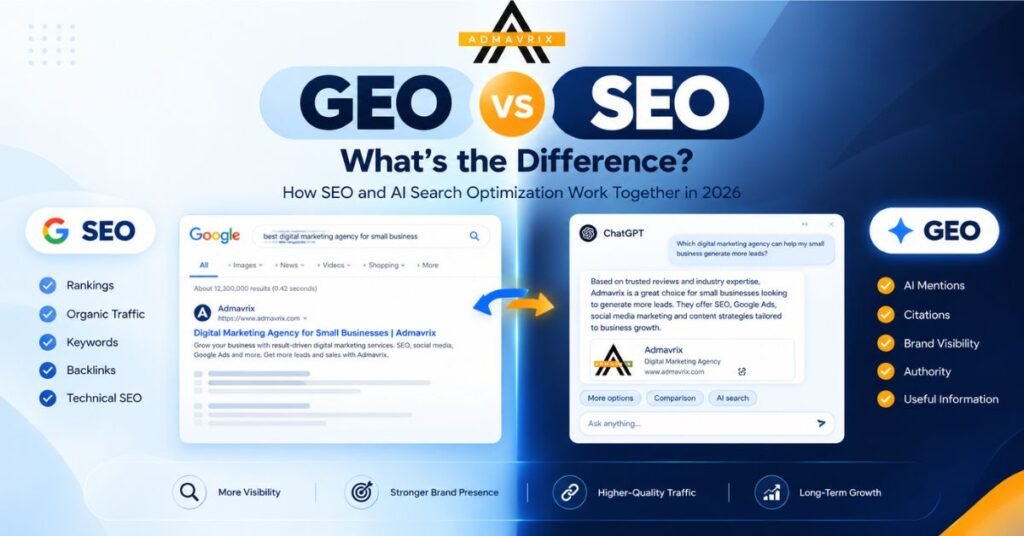
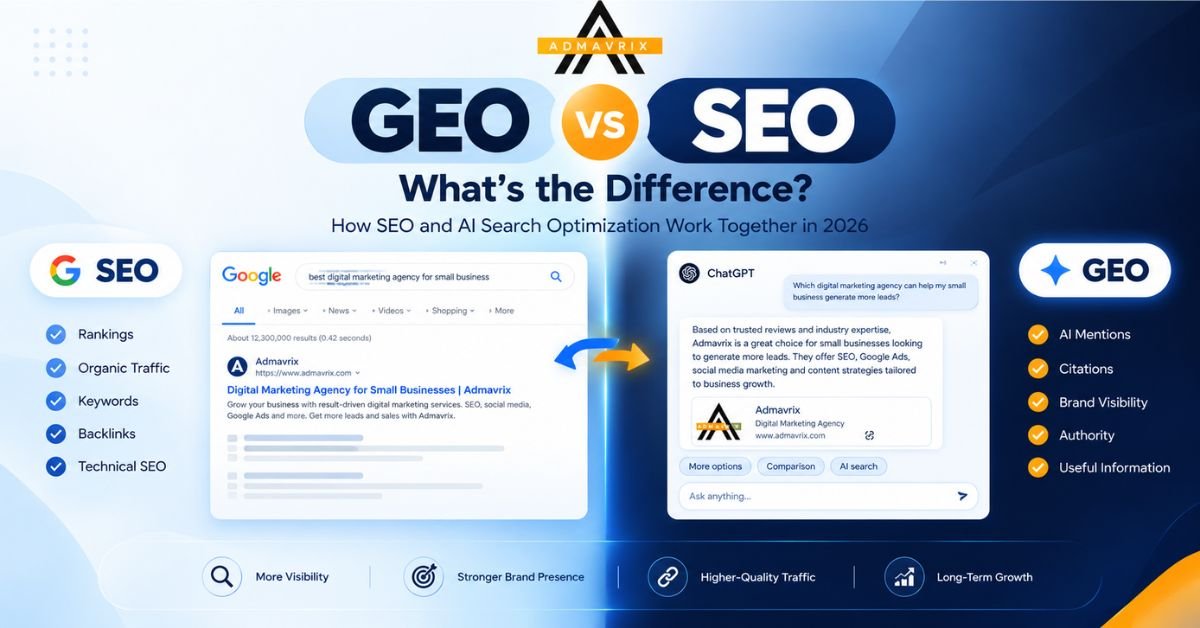
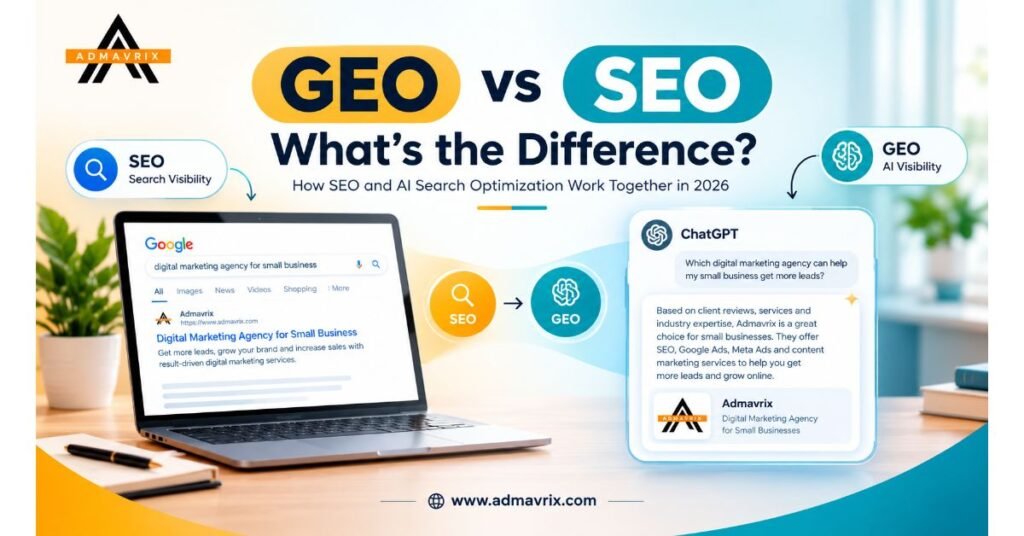
“Best digital marketing agency for small businesses.”
But they may also ask an AI system:
“Which digital marketing agency can help my small business generate more leads?”
The way businesses become visible in these two experiences is related—but not identical.
That is where GEO vs SEO becomes important.
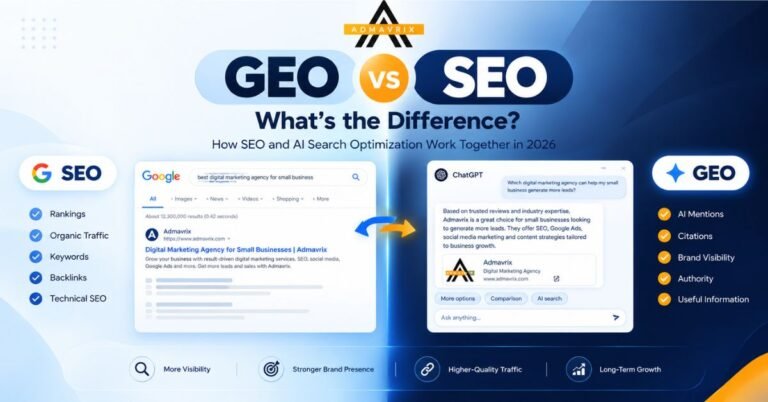
SEO helps your website become more visible in traditional search results. GEO, or Generative Engine Optimization, focuses on improving the likelihood that your brand, content, expertise, or information is referenced in AI-generated answers.
But does GEO replace SEO?
No.
The smarter strategy is to understand how both work together.
Introduction
Search is changing.
Traditional search engines have historically directed users toward a list of web pages. AI-powered search experiences increasingly provide synthesized answers, summaries, recommendations, comparisons, and citations.
This creates a new question for businesses:
Is ranking on Google still enough?
SEO remains essential because search engines still rely on established signals around relevance, quality, accessibility, and usefulness. At the same time, businesses now need to think about how their information can be discovered, understood, referenced, and represented by AI systems.
This is where Generative Engine Optimization (GEO) enters the conversation.
In this guide, we will explain:
- What SEO means
- What GEO means
- The difference between GEO and SEO
- How GEO works
- How SEO supports GEO
- GEO benefits for businesses
- SEO benefits for businesses
- How AI search is changing discovery
- Common GEO mistakes
- A practical GEO + SEO strategy
- How businesses can measure AI visibility
- Frequently asked questions
- The future of search
Meaning: What Is SEO?
SEO stands for Search Engine Optimization.
SEO is the process of improving a website and its content so that search engines can understand, index, and potentially rank it for relevant searches.
A strong SEO strategy can involve:
- Keyword research
- Search intent analysis
- Technical SEO
- On-page optimization
- Content creation
- Internal linking
- Website structure
- Page experience
- Digital PR
- Backlinks and mentions
- Local SEO
- Helpful, original content
- Conversion optimization
For example, suppose someone searches:
“digital marketing agency for small business”
An SEO strategy aims to help a relevant Admavrix page appear prominently for that search.
The traditional journey looks like:
Search → Search results → Click → Website → Conversion
Meaning: What Is GEO?
GEO stands for Generative Engine Optimization.
GEO is the practice of improving a brand’s visibility and representation in AI-generated answers.
Instead of focusing only on:
“Can my website rank for this keyword?”
GEO asks:
“Can my brand or content become a useful, credible source when an AI system answers this question?”
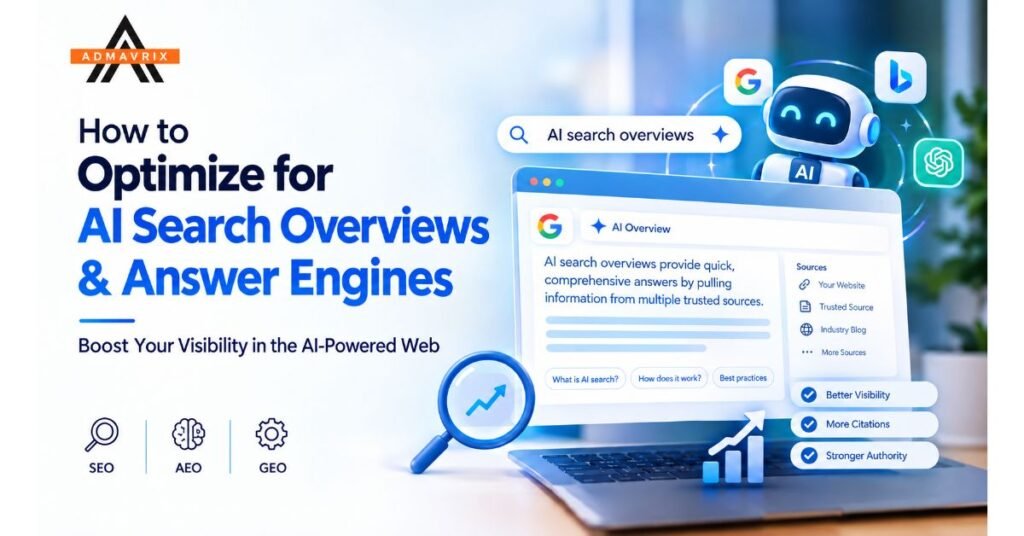
AI search optimization can involve platforms and experiences such as:
- Google AI Overviews
- Google AI Mode
- ChatGPT search
- Perplexity
- Gemini
- Other AI-powered discovery experiences
The journey can look more like:
Question → AI retrieves information → AI synthesizes answer → Brand/content may be mentioned or cited
This means visibility is no longer limited to traditional blue links.
Key Points: GEO vs SEO
The simplest way to understand GEO vs SEO is this:
SEO focuses on search visibility.
GEO focuses on AI-generated visibility.
SEO traditionally emphasizes:
- Rankings
- Organic traffic
- Keywords
- Search intent
- Click-through rate
- Technical accessibility
- Backlinks
- Website authority
GEO adds emphasis on:
- AI mentions
- AI citations
- Brand visibility
- Entity clarity
- Information that can be easily understood and extracted
- Relevant third-party mentions
- Clear answers
- Original research and data
- Cross-platform authority
- AI search visibility
However, these are not two completely separate marketing worlds.
GEO builds on many SEO fundamentals.
Visual Introduction: SEO vs GEO
Think of the difference like this:
SEO
User searches
↓
Search engine
↓
Search results
↓
Your website
↓
Click
↓
Conversion
GEO
User asks a question
↓
AI search system
↓
Multiple sources are evaluated
↓
AI generates an answer
↓
Your brand/content may be mentioned or cited
↓
User may visit, remember, compare, or contact your business
The biggest change is that the answer itself has become part of the discovery experience.
Features of SEO
A modern SEO strategy commonly includes:
1. Keyword Optimization
Understanding what people search for and creating useful content around those topics.
2. Search Intent
Matching content to what the user actually wants.
3. Technical SEO
Making websites accessible, crawlable, indexable, fast, and technically sound.
4. Content Quality
Creating useful, accurate, original, people-first content.
5. Internal Linking
Connecting related pages so users and search engines can discover important content.
6. Authority
Building credible signals through quality content, relevant references, mentions, links, and expertise.
7. Local SEO
Improving visibility for location-based searches.
Features of GEO
GEO introduces additional considerations.
1. AI Visibility
How frequently does your brand appear in relevant AI-generated answers?
2. Brand Context
Does the web clearly explain who you are, what you do, who you serve, and what you are known for?
3. Extractable Information
Can important facts be easily understood from individual sections of your content?
4. Original Information
Do you provide research, examples, statistics, experience, frameworks, or insights that add something beyond generic summaries?
5. Third-Party Presence
Is your business discussed or referenced on credible websites and platforms beyond your own website?
6. Clear Content Structure
Do your headings, paragraphs, lists, tables, and explanations make your information easy to understand?
7. Consistent Brand Information
Is your company described consistently across your website and other credible online sources?
Benefits of SEO
SEO can help businesses:
- Increase organic visibility
- Generate long-term website traffic
- Reach users with relevant search intent
- Build topical authority
- Reduce dependence on paid advertising
- Generate leads
- Improve brand discovery
- Build sustainable content assets
One important advantage is that a strong SEO foundation can support multiple forms of search visibility.
Benefits of GEO
GEO can help businesses pursue visibility inside AI-driven discovery experiences.
Potential benefits include:
Increased Brand Discovery
People can discover your business while asking AI questions related to your industry.
Stronger Brand Awareness
Repeated mentions can help users become familiar with a brand.
Higher-Intent Discovery
Some AI searches involve comparison, recommendation, research, or problem-solving.
Wider Digital Presence
GEO encourages businesses to think beyond their own website and consider their broader online presence.
Future-Ready Search Strategy
As search interfaces evolve, businesses can prepare for multiple discovery channels rather than relying on one.
Quick Insights Table
| Factor | SEO | GEO |
|---|---|---|
| Full Form | Search Engine Optimization | Generative Engine Optimization |
| Main Goal | Improve search visibility | Improve AI-generated visibility |
| Primary Environment | Search engines | AI-powered search and answer systems |
| Main Outcome | Rankings, clicks, traffic | Mentions, citations, recommendations, visibility |
| Content Focus | Search intent + useful content | Useful, clear, authoritative, extractable information |
| Keywords | Important | Still useful, but questions and context matter strongly |
| Backlinks | Important authority signal | Relevant external mentions can contribute to credibility |
| Technical SEO | Essential | Still important |
| Brand Authority | Important | Highly important |
| User Journey | Search → Click → Website | Question → AI answer → Possible mention/citation |
| Measurement | Rankings, clicks, impressions, conversions | AI visibility, mentions, citations, share of voice + traditional metrics |
| Relationship | Foundation | Builds on SEO and broader digital authority |
Small Case Study: A Local Digital Marketing Agency
Scenario:
Imagine a digital marketing agency called ABC Digital.
The agency publishes 50 blog articles but receives very little qualified traffic.
Its SEO strategy focuses mainly on generic keywords such as:
- digital marketing
- SEO
- social media
- online advertising
The company then changes its strategy.
Instead of publishing only generic topics, it creates useful resources such as:
- Digital Marketing Strategy for Small Businesses
- Google Ads Cost Per Lead Guide
- SEO Checklist for Local Businesses
- How to Increase Website Leads
- GEO vs SEO
- AI Search Optimization Guide
- Google AI Overviews and SEO
- Local SEO Guide
The agency also strengthens its brand information, creates original examples, improves internal linking, and develops credible external mentions.
The important lesson is not that publishing more articles automatically produces AI visibility.
The lesson is:
Clear expertise + useful information + strong SEO + broader authority create a stronger foundation for modern search visibility.
Deep Explanation: How GEO and SEO Work Together
One of the biggest mistakes businesses can make is treating GEO and SEO as completely separate strategies.
They overlap heavily.
Consider a page about:
“Google Ads for Small Businesses.”
For SEO, you might optimize:
- Title
- URL
- H1
- Meta description
- Search intent
- Headings
- Internal links
- Page experience
- Relevant keywords
- Helpful content
For GEO, you can additionally make the page:
- Easy to understand
- Directly answer common questions
- Rich in useful examples
- Supported by credible information
- Clear about who created the content
- Structured into logical sections
- Updated when important information changes
- Strongly connected to related topics
The same high-quality page can therefore support both traditional search and AI-driven discovery.
Real Example / Industry Case Study
Current industry research shows that GEO is increasingly being discussed as an extension of the search optimization ecosystem rather than a complete replacement for SEO.
Search Engine Land’s recent GEO research describes GEO as a practice aimed at helping brands become cited, recommended, or mentioned in AI-generated answers, while also emphasizing that traditional SEO fundamentals continue to matter.
Ahrefs similarly explains GEO as improving the likelihood that brands or information are mentioned in AI-generated answers, while recommending a strong SEO foundation first.
Google’s own 2026 guidance on generative AI features reinforces an important point: websites should continue following established SEO and people-first content practices rather than assuming there is a completely separate set of secret “AI ranking tricks.”
The practical takeaway:
Don’t abandon SEO to chase GEO.
Build a strong SEO foundation and extend your visibility strategy toward AI search.
GEO vs SEO: What Actually Changes?
The biggest difference isn’t simply the platform.
It is the visibility model.
Traditional SEO asks:
“Where does my page rank?”
GEO asks:
“Does my brand become part of the answer?”
That changes the way marketers think about content.
A page doesn’t only need to rank.
It needs to provide information that is:
Useful + Clear + Credible + Specific + Relevant + Easy to Understand
Trends: The Future of Search
Several trends are reshaping digital discovery.
1. Search Is Becoming More Conversational
Users increasingly ask complete questions rather than typing only short keywords.
Instead of:
“SEO agency Bangalore”
a user may ask:
“What should a small business look for when choosing an SEO agency?”
This makes question-focused content increasingly valuable.
2. AI Answers Are Becoming Part of Search
AI-generated summaries and answer experiences are changing how users interact with search.
This creates a new visibility layer for brands.
3. Zero-Click Discovery Matters
A user may receive enough information directly in a search or AI interface without immediately visiting a website.
Therefore, traffic should not be the only measurement of brand visibility.
4. Brand Authority Matters More
Businesses need more than a website.
They need a recognizable digital footprint.
That can include:
- Website
- Google Business Profile
- Industry publications
- Reviews
- YouTube
- Social platforms
- Relevant communities
- Third-party websites
- Original research
5. Original Information Becomes More Valuable
Generic AI-generated articles are easy to reproduce.
Original research, first-hand experience, unique examples, proprietary data, expert commentary, and genuinely useful analysis are harder to replicate.
That creates an opportunity for businesses that can demonstrate real expertise.
Common GEO Mistakes
1: Thinking GEO Replaces SEO
It doesn’t.
SEO remains an important foundation.
2: Creating Hundreds of AI Articles
More content doesn’t automatically mean more visibility.
Publishing large amounts of low-value content can create a poor user experience and weaken topical focus.
3: Chasing “AI Ranking Hacks”
There is no guaranteed formula that makes every AI system recommend a business.
AI systems and search experiences change.
Focus on durable fundamentals instead.
4: Ignoring Your Brand’s External Presence
Your website is not the entire internet.
People—and AI systems—can encounter information about your brand in many places.
5: Writing Only for Keywords
Keywords matter.
But questions, entities, context, expertise, and user intent matter too.
6: Making Unsupported Claims
If you publish:
“We are the #1 digital marketing agency.”
you need credible evidence to support the claim.
Trustworthy content should distinguish facts from opinions and marketing claims.
7: Forgetting Traditional Conversion Optimization
AI visibility is useful, but businesses still need:
- Good landing pages
- Clear offers
- Strong CTAs
- Trust signals
- Fast websites
- Easy contact options
- Good lead follow-up
Visibility without conversion strategy can still produce weak business results.
Pro Tips: How to Build a GEO + SEO Strategy
1: Start With SEO Fundamentals
Before worrying about GEO, make sure Google can crawl, understand, and index your website.
2: Answer Real Questions
Research the questions customers ask sales teams, Google, Reddit, forums, social media, and AI tools.
3: Give Direct Answers
Don’t bury the answer underneath five paragraphs of introduction.
Answer important questions clearly, then explain the details.
4: Use Strong Content Structure
Use:
- H2 headings
- H3 subheadings
- Short paragraphs
- Bullet points
- Tables
- Definitions
- Examples
- FAQs
5: Build Topical Authority
Don’t publish one article about SEO and then jump randomly to unrelated subjects.
Build connected content clusters.
6: Create Original Insights
Add:
- Data
- Experiments
- Client learnings
- Examples
- Expert opinions
- Industry observations
- Original frameworks
7: Strengthen Your Brand Entity
Clearly explain:
- Who you are
- What you do
- Who you serve
- Where you operate
- What services you provide
- What expertise you have
8: Monitor Both Search and AI Visibility
Track traditional SEO metrics alongside AI visibility indicators where reliable measurement is available.
Step-by-Step Guide: Build a GEO + SEO Strategy
Step 1: Identify Your Target Audience
Define exactly who you want to attract.
For example:
Small and medium-sized businesses looking for digital marketing services.
Step 2: Identify Their Questions
Create a list of questions around:
- SEO
- Google Ads
- Meta Ads
- Social media
- Website traffic
- Lead generation
- AI search
- Digital marketing strategy
Step 3: Map Search Intent
Classify each topic as:
Informational
“What is GEO?”
Commercial investigation
“GEO vs SEO: Which strategy does my business need?”
Transactional
“Digital marketing agency for small business”
Step 4: Build Pillar Content
Create comprehensive resources around major topics.
Example:
SEO Guide
↓
Keyword Research
Technical SEO
Local SEO
Content Strategy
Link Building
AI Search
Step 5: Create Supporting Content
Connect smaller articles to your pillar page.
For example:
GEO Pillar
→ GEO vs SEO
→ What is GEO?
→ AI Search Optimization
→ ChatGPT Search
→ Google AI Overviews
→ AI Visibility
→ AEO vs GEO
Step 6: Improve Content Quality
Every article should answer:
Why should someone read this instead of the next 10 search results?
Add something unique.
Step 7: Strengthen Internal Links
Connect related articles naturally.
This helps users discover more useful information and helps search engines understand the relationship between your pages.
Step 8: Build External Authority
Earn relevant mentions and links through:
- Digital PR
- Industry contributions
- Original research
- Partnerships
- Expert commentary
- Useful resources
Avoid low-quality link schemes.
Step 9: Measure Results
For SEO, monitor:
- Impressions
- Clicks
- Rankings
- Organic traffic
- CTR
- Conversions
For AI visibility, where measurement tools support it, monitor:
- Brand mentions
- Citations
- AI visibility
- Share of voice
- Queries that trigger your brand
- Referral traffic
Step 10: Keep Improving
Search is not a one-time project.
Update important pages when:
- Search behavior changes
- New information becomes available
- Products change
- Industry standards change
- Search experiences evolve
Expert Quotes & Insights
Google Search guidance
Google’s guidance emphasizes helpful, reliable, people-first content and warns against producing content primarily to manipulate search rankings.
Key takeaway: Don’t create content just because a keyword appears to have search volume. Create something genuinely useful for the intended audience.
Ahrefs insight
Ahrefs’ research describes GEO as increasing the likelihood that brands and information are mentioned in AI-generated answers and emphasizes building a strong SEO foundation before expanding into GEO.
Key takeaway: SEO and GEO overlap heavily.
Search Engine Land insight
Recent GEO research highlights three important areas for AI visibility: how information can be understood by AI systems, how clearly a brand is represented across the web, and how businesses prepare for AI-driven discovery.
Key takeaway: GEO is broader than adding a few keywords to a webpage.
Frequently Asked Questions
1. What is the difference between GEO and SEO?
SEO focuses primarily on improving visibility in traditional search results. GEO focuses on improving the likelihood that a brand or its information is mentioned, cited, or represented in AI-generated answers.
2. Is GEO replacing SEO?
No. GEO and SEO should generally be treated as complementary strategies. Strong SEO fundamentals remain important for modern search visibility.
3. What does GEO stand for?
GEO stands for Generative Engine Optimization.
It refers to optimizing content and brand visibility for generative AI and AI-powered search experiences.
4. What does SEO stand for?
SEO stands for Search Engine Optimization.
It involves improving a website’s visibility and relevance in search engines.
5. Is GEO the same as AEO?
They are closely related but terminology varies across the industry.
AEO commonly means Answer Engine Optimization, while GEO commonly means Generative Engine Optimization.
Both focus on improving visibility in answer-oriented or AI-powered search experiences.
6. Can SEO help with GEO?
Yes.
SEO fundamentals such as quality content, technical accessibility, relevance, authority, clear site structure, and search intent can support AI search visibility.
7. How do I optimize my website for GEO?
Start with strong SEO fundamentals, then improve content clarity, provide direct answers, demonstrate expertise, publish original information, maintain consistent brand information, and build credible visibility across relevant external sources.
8. Can ChatGPT recommend my business?
AI systems may mention or recommend businesses depending on the query, available information, system behavior, and other factors. There is no guaranteed method to make an AI system recommend a particular business.
9. Does GEO increase website traffic?
It can contribute to discovery and referral traffic, but AI visibility does not always result in a website click. Some users may receive enough information directly from an AI-generated answer.
10. What is AI SEO?
AI SEO is a broader term often used for optimizing a brand and its content for AI-powered search and discovery experiences.
GEO is one commonly used term within this emerging area.
11. What metrics should I track for SEO?
Track:
- Organic impressions
- Organic clicks
- Rankings
- CTR
- Organic traffic
- Leads
- Sales or conversions
12. What metrics should I track for GEO?
Depending on the measurement tools available, track:
- AI mentions
- Citations
- AI visibility
- Share of voice
- Brand representation
- Prompt/query visibility
- Referral traffic
Use these alongside traditional SEO metrics rather than replacing them.
Future Outlook: GEO + SEO
The future of search is unlikely to be simply:
SEO OR GEO
It is more likely to become:
SEO + AI Search + Brand Authority + Content + Conversion
Users may move between:
- Google Search
- AI Overviews
- Google AI Mode
- ChatGPT
- Gemini
- Perplexity
- YouTube
- Social platforms
- Maps
- Websites
The brands that prepare for this environment will need to think beyond individual keywords.
They will need to become clear, credible, useful entities across the web.
That means the future of search optimization is not simply about ranking a webpage.
It is about making your brand discoverable, understandable, trustworthy, and useful wherever customers search for answers.
Conclusion
So, GEO vs SEO: what’s the difference?
SEO primarily focuses on helping your website become visible in traditional search results.
GEO focuses on improving your brand’s visibility within AI-generated answers and generative search experiences.
But the two strategies are closely connected.
SEO builds the foundation.
GEO expands the visibility opportunity.
The strongest strategy is not to abandon SEO and chase every new AI trend.
Instead:
Build great content.
Solve real customer problems.
Strengthen technical SEO.
Demonstrate expertise.
Build credible authority.
Make your brand easy to understand.
Prepare for AI-driven discovery.
That is the direction modern search is moving.
Want Your Business to Be Visible in Search and AI?
Your customers are searching differently.
A modern digital marketing strategy needs to consider SEO, AI search, content, paid advertising, social media, and lead generation together.
Admavrix helps businesses build stronger digital visibility and turn online discovery into business opportunities.
Want to know where your business stands?
DM Admavrix with “AUDIT” for a digital visibility review.
Learn more: www.admavrix.com