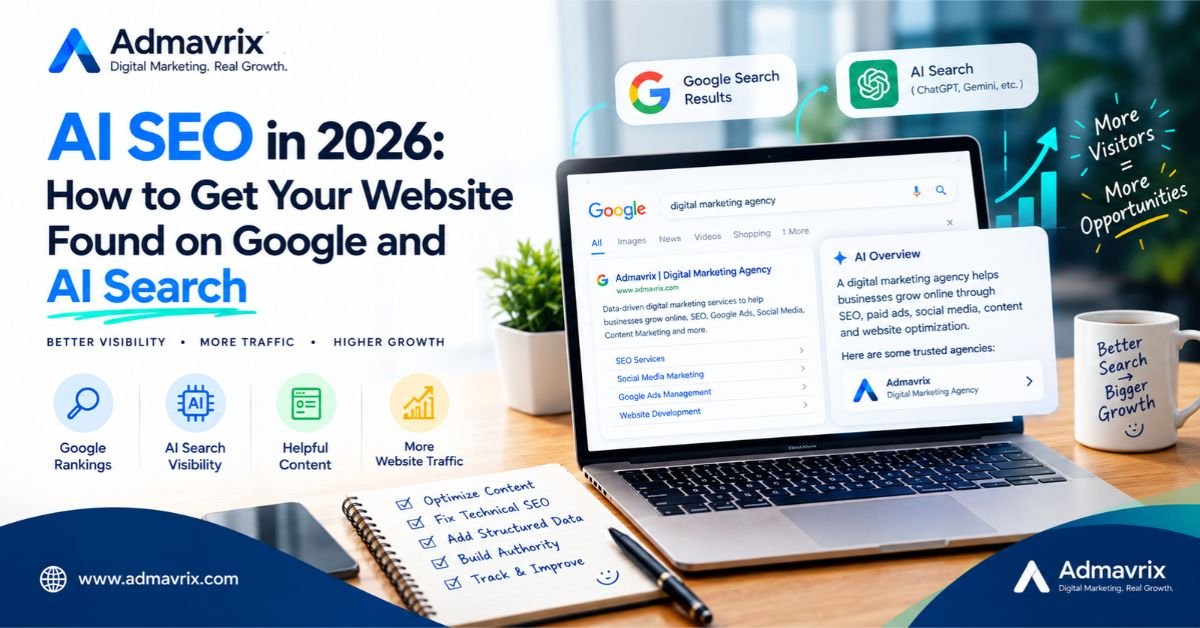
Is Your Website Ready for the New Era of Search?
Imagine someone searching for a digital marketing agency, an SEO consultant, or a solution to a business problem. Instead of clicking through several websites, they may receive an AI-generated summary that answers their question and recommends relevant sources.
Will your website be one of the sources they discover?
In 2026, businesses need to understand how people find information through traditional Google search results, AI Overviews, AI Mode, and other AI-powered search experiences. A website that depends only on outdated keyword tactics may miss opportunities to reach potential customers.
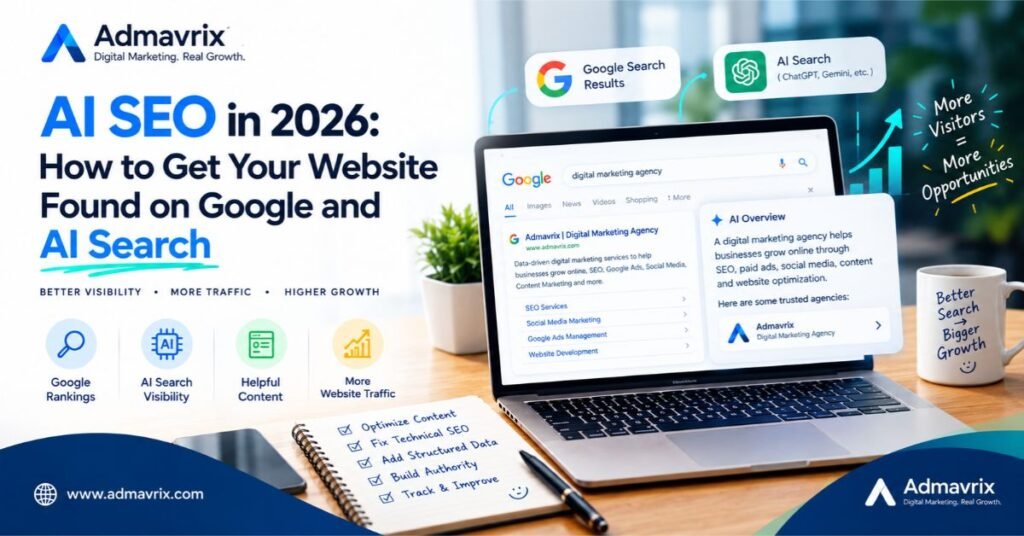
AI SEO in 2026 is about making your website useful, trustworthy, technically accessible, and relevant enough to be discovered through modern search experiences.
For small businesses, startups, and growing brands, this creates an opportunity to attract relevant visitors, establish expertise, and turn online visibility into enquiries.
In this guide, you will learn what AI SEO means, how Google and AI search work, which strategies matter, common mistakes to avoid, and how to build a practical optimization plan.
Introduction
Search engine optimization has evolved beyond simply inserting keywords into web pages. Search engines increasingly use advanced systems to understand user intent, identify relevant information, and present answers in different formats.
Google’s AI search experiences, including AI Overviews and AI Mode, provide new ways for people to explore information. Other platforms, including ChatGPT, also help users discover information and sources.
However, businesses should not assume that AI search has replaced traditional SEO. Google’s official documentation explains that the foundational SEO practices used for ordinary search remain relevant to its AI search features.
This means businesses should focus on creating original content, maintaining a technically accessible website, answering real customer questions, and building trust.
For example, a digital marketing agency should not publish only a generic article titled “What Is SEO?” It could provide a more useful resource explaining how a local business can improve Google visibility, measure website enquiries, and decide which SEO activities to prioritize.
That level of practical value helps readers understand the subject and gives them a reason to explore more pages on the website.
What Is AI SEO?
AI SEO is the process of improving website content, technical accessibility, relevance, and credibility so that search engines and AI-powered discovery experiences can understand and potentially surface the website.
It combines established SEO fundamentals with an understanding of how AI systems retrieve, interpret, and present information.
AI SEO can involve:
- Researching the questions customers actually ask.
- Creating accurate, original, and comprehensive content.
- Organizing information with descriptive headings and clear explanations.
- Improving website speed, mobile usability, and crawlability.
- Strengthening internal links and relevant external references.
- Using structured data where appropriate.
- Measuring performance in traditional search and available AI-search reporting tools.
AI SEO does not mean using AI to generate hundreds of articles or inserting the phrase “AI SEO” repeatedly into every page.
The objective is to make valuable information easier for people and search systems to find, understand, and trust.
AI SEO vs Traditional SEO vs GEO
| Approach | Primary focus | Example |
|---|---|---|
| Traditional SEO | Organic visibility in search engines | Improving a page targeting “digital marketing agency” |
| AI SEO | Applying SEO fundamentals to AI-powered discovery | Creating a useful, well-structured guide that can be understood by AI search systems |
| GEO | Improving the likelihood of relevant content being surfaced or cited in generative-engine responses | Publishing original research and clear answers to customer questions |
| AEO | Making content suitable for direct answers to specific questions | Answering a question concisely in a well-organized FAQ |
These approaches overlap. GEO and AEO are useful industry terms, but they are not substitutes for technical SEO, helpful content, or a sound website strategy.
Why Is AI SEO Important in 2026?
AI-powered search is changing how people discover and evaluate information. Google’s June 2026 announcement reported more than 2.5 billion monthly active users of AI Overviews and more than one billion monthly users of AI Mode. These are Google-reported figures and illustrate the scale of its AI search experiences.
For businesses, the important question is not simply whether AI search is popular. It is whether potential customers use these experiences to research products, compare services, or solve problems relevant to your business.
AI SEO can help businesses work toward several objectives:
- Improve discoverability: Make useful pages easier for search systems to understand.
- Reach relevant audiences: Answer specific questions related to your products and services.
- Build credibility: Demonstrate expertise through evidence, useful explanations, and accurate information.
- Support customer decisions: Provide comparisons, examples, and practical recommendations.
- Strengthen organic marketing: Build useful resources that can attract visitors over time.
Visibility is not guaranteed, and AI search can sometimes answer questions without generating a website visit. Therefore, businesses should measure qualified traffic, enquiries, conversions, and the overall value of their search presence.
Key Points: What Matters Most for AI SEO?
The following practices provide a useful starting point.
- Helpful content: Publish information that genuinely answers the reader’s question.
- Search intent: Match each page to what the user wants to learn, compare, or accomplish.
- Technical SEO: Ensure important pages can be crawled, indexed, and rendered correctly.
- Clear structure: Use descriptive headings, short paragraphs, tables, and meaningful examples.
- Credibility: Include accurate claims, reliable sources, and transparent authorship.
- Original value: Add your own analysis, examples, data, or practical experience.
- Relevant internal links: Connect related articles and service pages.
- Measurement: Monitor impressions, clicks, leads, and conversions instead of focusing only on rankings.
Google’s official guidance on AI search emphasizes that there are no special technical requirements or guaranteed optimization tricks for appearing in AI Overviews or AI Mode. Eligibility in ordinary Google Search remains an important foundation.
Visual Introduction: How AI SEO Works
Think of AI SEO as a process that connects your expertise to the questions your potential customers ask.
Customer question → Useful content → Crawlable and indexable page → Search-system understanding → Potential visibility → Website visit → Business enquiry
Each stage matters.
For example, a business owner may search for ways to reduce advertising costs. Your website could provide a detailed guide explaining campaign structure, conversion tracking, landing-page improvements, and lead quality.
If the page is accessible, relevant, and useful, it may become eligible to appear in appropriate search results. Whether it actually appears depends on Google’s systems, competition, relevance, and many other factors.
Once the visitor reaches your website, a clear call to action can help them explore your services or request a consultation.
Features of an Effective AI SEO Strategy
1. Search Intent Analysis
Understand why someone searches for a particular phrase.
A user searching “what is AI SEO” probably wants an explanation. Someone searching “AI SEO agency in Bengaluru” may be comparing service providers.
Create content that matches the intent instead of forcing every keyword into a sales page.
2. Topic Clusters and Semantic Relevance
Organize related content around meaningful topics.
For example, a website covering AI SEO could also publish supporting guides about:
- Technical SEO audits.
- Google AI Overviews.
- Search intent and keyword research.
- Content quality and topical expertise.
- Website indexing and crawlability.
- Organic traffic measurement.
- Conversion optimization.
Link related pages together when the links help readers navigate the subject.
3. Structured and Understandable Content
Use one clear main heading, descriptive subheadings, lists, and tables where they improve comprehension.
Provide a direct answer near the beginning of each major section, then explain the reasoning and practical details.
4. Technical Accessibility
Make sure search engines can access the pages you want to appear in search results. Check crawl errors, indexing, canonical URLs, robots directives, mobile usability, and page performance.
5. Trust and Evidence
Support important claims with reliable references. Explain who created the article and include genuine experience or original analysis where available.
Avoid fake author credentials, invented customer testimonials, and unsupported performance statistics.
Benefits of AI SEO for Businesses
| Benefit | How it can help |
|---|---|
| Search visibility | Makes relevant pages eligible for discovery across search experiences |
| Qualified website traffic | Attracts people researching problems your business can solve |
| Brand credibility | Demonstrates knowledge through useful, evidence-based resources |
| Content efficiency | Helps organize research and identify gaps in existing content |
| Better user experience | Makes information easier to navigate and understand |
| Lead generation | Connects informational content to relevant services and enquiry pages |
| Long-term value | Builds a library of useful content that can continue attracting visitors |
These are potential benefits, not guaranteed outcomes. Results depend on competition, content quality, website health, search demand, and how audiences behave.
Quick Insights Table
| Question | Practical answer |
|---|---|
| Is traditional SEO still important? | Yes. It remains foundational to Google AI search visibility. |
| Do I need a separate AI sitemap? | No special AI sitemap is required for Google AI Overviews or AI Mode. |
| Should I use FAQ sections? | Use them when they answer genuine user questions. |
| Does publishing more content guarantee traffic? | No. Quality, usefulness, relevance, and competition matter. |
| Should I use AI to write articles? | AI can assist, but the final content needs fact-checking, human judgment, and original value. |
| Can small businesses benefit? | Yes, particularly when they serve a defined audience and answer specific customer needs. |
| Can I guarantee an AI citation? | No. No legitimate SEO strategy can guarantee inclusion in AI-generated answers. |
Step-by-Step Guide: How to Implement AI SEO in 2026
Step 1: Identify Your Target Audience
Start by understanding who you want to reach.
For Admavrix, potential audiences may include small-business owners, startups, local businesses, and marketing professionals.
Ask:
- What problems are they trying to solve?
- What questions do they search for?
- What information do they need before contacting an agency?
- Which services could genuinely help them?
This research helps you create content that attracts relevant visitors rather than unrelated traffic.
Step 2: Find Relevant Keywords and Questions
Use Google Search Console, Google Keyword Planner, and suitable keyword research tools to identify relevant searches.
For this article, the primary focus keyword is “AI SEO in 2026.”
Related keyword ideas include:
- AI SEO strategy.
- SEO for AI search.
- Google AI Overviews optimization.
- AI search optimization.
- Generative engine optimization.
- Website organic traffic.
- AI SEO best practices.
These are keyword targets, not verified search-volume estimates. Check demand and competition before deciding which terms deserve separate articles.
Do not create a separate page for every slight keyword variation. Combine closely related questions when one comprehensive page can answer them better.
Step 3: Audit Your Website
Before publishing more articles, review the technical health of your website.
Check whether:
- Important pages return the correct HTTP status.
- Relevant pages are indexed or eligible for indexing.
- XML sitemaps are accessible and up to date.
- Canonical tags point to the intended URLs.
- Internal links lead to relevant, working pages.
- Mobile pages are readable and usable.
- Important content is accessible without relying on unsupported rendering behavior.
Use Google Search Console and a website crawling tool to identify issues.
Step 4: Create People-First Content
Write for the person who needs the information, not for a keyword counter.
A useful AI SEO article should explain the topic, offer practical steps, address limitations, and answer common questions.
Add value that competing pages may not provide, such as an original checklist, a comparison table, a worked example, or a transparent analysis of results.
Google does not prescribe a preferred word count for ranking. Make the article as comprehensive as the topic requires without adding unnecessary repetition.
Step 5: Improve Page Structure
Organize the article so readers can find answers quickly.
Use:
- One descriptive H1.
- Logical H2 and H3 headings.
- Short, readable paragraphs.
- Lists and tables where appropriate.
- Descriptive image alt text.
- Relevant internal links.
- A clear introduction and conclusion.
A strong structure helps readers understand the information. It does not guarantee that an AI system will quote or cite the page.
Step 6: Add Relevant Internal and External Links
Internal links help users discover related pages on your website and help search engines understand how pages relate to one another.
For Admavrix, this article could link to relevant existing resources about SEO services, website development, digital marketing strategy, and content marketing.
External links should point to authoritative sources that support the claims being made.
Useful official references include:
- Google Search Central: AI Features and Your Website
- Google Search Central: AI Optimization Guide
- Google Search Central: Helpful, Reliable, People-First Content
Only link to Admavrix pages that actually exist and are relevant to the surrounding content.
Step 7: Use Structured Data Correctly
Structured data helps search engines understand certain types of information on a page.
Depending on the page and your website, relevant schema types may include Article, Organization, BreadcrumbList, and appropriate business information.
Use valid markup that reflects visible page content. Structured data does not guarantee rich results, AI citations, or higher rankings.
Do not add irrelevant schema simply to target AI search.
Step 8: Optimize Images and Page Experience
Use descriptive image filenames, relevant alt text, appropriately sized images, and modern image formats when supported.
Check mobile readability, page loading performance, intrusive pop-ups, and navigation.
For the featured image, use a descriptive filename such as ai-seo-google-ai-search-2026.webp.
Suggested alt text: “AI SEO strategy for improving website visibility in Google and AI search.”
Step 9: Build Credibility
Make it clear who wrote or reviewed the article. Link to a genuine author profile where appropriate.
Use credible sources, explain your reasoning, and distinguish verified information from examples or estimates.
If Admavrix conducts an SEO audit or tests a tool, document the actual process and findings. Do not present hypothetical results as a real client success story.
Step 10: Measure and Improve
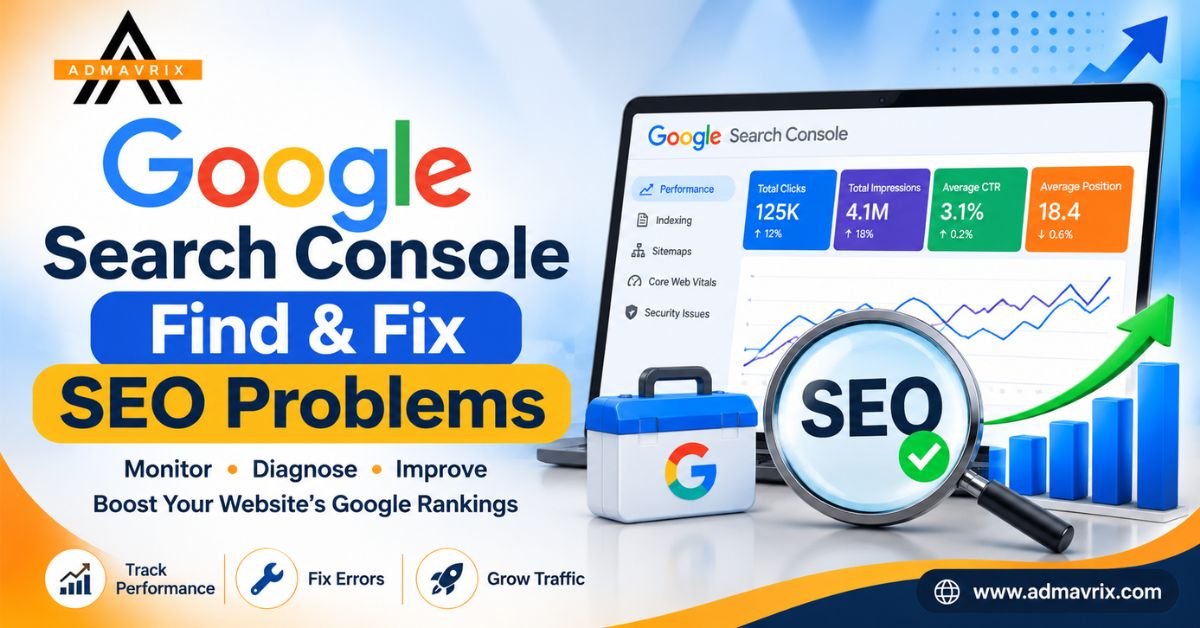
Use Google Search Console to monitor impressions, clicks, click-through rate, and average position for relevant queries.
Use analytics tools to understand engaged sessions, enquiry submissions, and other meaningful conversions.
If AI-search reporting is available for your property, review it as an additional source of insight. Google announced new AI-search reporting features in 2026, with worldwide availability reported in its updated announcement.
Review the article periodically. Update it when meaningful information changes, not merely to change the publication date.
Small Case Study: A Practical AI SEO Improvement Plan
Scenario: A hypothetical digital marketing agency
Imagine a digital marketing agency whose website receives some organic traffic but few enquiries.
The agency identifies several problems:
- Its blog articles answer broad questions but offer little original insight.
- Service pages are difficult to discover from informational articles.
- Some important pages have weak internal linking.
- The website does not clearly explain the agency’s expertise.
- The team tracks page views but does not consistently measure enquiries.
The agency implements an AI SEO improvement plan.
| Area | Before | Improvement |
|---|---|---|
| Content | Generic explanations | Detailed guides with actionable examples |
| Search intent | Broad topics | Specific customer questions |
| Internal links | Inconsistent | Relevant links to services and related guides |
| Trust | Limited author information | Genuine author details and cited sources |
| Conversion tracking | Page views only | Enquiry submissions and qualified leads |
| Technical SEO | Irregular checks | Routine crawl and indexing reviews |
The agency then measures performance over a defined period and compares results with the previous period.
This example illustrates a process, not a verified client result. Actual traffic and conversion improvements would need to be measured using real website data.
Real Example: How Admavrix Could Apply AI SEO
Consider a hypothetical Indian small business looking for help with online advertising.
Its owner asks an AI search tool: “Why are my Google Ads getting clicks but no leads?”
Admavrix could publish a detailed resource explaining:
- How to evaluate keyword intent.
- Why ad messaging must match the landing page.
- How to identify form and mobile usability problems.
- Why conversion tracking needs to be verified.
- How to distinguish raw enquiries from qualified leads.
The article should include practical examples, relevant references, and links to the agency’s actual Google Ads or lead-generation service pages.
A reader who discovers the article may then explore the service pages or request a consultation.
The important principle is that the article solves a real problem before promoting a service. Whether it appears in Google or an AI response depends on relevance, competition, technical eligibility, and the search system’s selection process.
AI SEO Trends to Watch in 2026
1. AI Overviews and AI Mode
Google’s AI search features give users additional ways to explore questions and discover supporting web pages. Businesses should continue investing in strong technical SEO and helpful content.
2. Generative Engine Optimization
GEO is receiving attention as marketers study how content is surfaced or cited in generative AI responses. Focus on original information and clear evidence rather than chasing unverified ranking tricks.
3. More Specific, Problem-Led Content
Detailed pages answering real customer questions can serve users better than generic content written only around high-level keywords.
4. Stronger Emphasis on First-Hand Value
Original analysis, genuine experience, useful demonstrations, and transparent sourcing help differentiate a page from repetitive content found across many websites.
5. Measurement Beyond Rankings
Businesses should evaluate the complete journey: search impressions, clicks, engaged visits, enquiries, qualified leads, and conversions.
6. Human Oversight of AI-Assisted Content
AI tools can help with research, outlines, and editing. Human review remains important for accuracy, originality, relevance, and quality.
Common AI SEO Mistakes to Avoid
Mistake 1: Publishing mass-produced AI articles
Producing many similar articles without adding value can create a poor experience for readers. Prioritize useful, original content.
Mistake 2: Believing GEO replaces SEO
Technical accessibility, indexing, relevance, and content quality remain important. GEO should complement these fundamentals.
Mistake 3: Keyword stuffing
Repeating “AI SEO in 2026” unnaturally makes content harder to read. Use the phrase in important locations and write naturally elsewhere.
Mistake 4: Inventing statistics or case studies
Do not fabricate traffic increases, customer outcomes, expert endorsements, or research findings. Label hypothetical examples clearly.
Mistake 5: Ignoring search intent
An article targeting an informational query should answer the question before pushing a sales pitch.
Mistake 6: Adding schema that does not match the page
Structured data must be relevant and accurate. It is not a shortcut to AI citations.
Mistake 7: Ignoring technical SEO
Even excellent content can struggle to appear if important pages are blocked, inaccessible, or incorrectly canonicalized.
Mistake 8: Measuring success only through keyword rankings
Rankings matter, but qualified traffic and meaningful business outcomes matter too.
Pro Tips for Better AI SEO Results
- Answer the primary question early in the article.
- Use descriptive headings that communicate what each section covers.
- Include original examples, screenshots, comparisons, and practical checklists.
- Cite reliable sources for factual claims.
- Link to relevant supporting articles and service pages.
- Make authorship and business information easy to verify.
- Keep important website content accessible to search crawlers.
- Review Google Search Console data to identify opportunities.
- Track enquiries and conversions alongside organic traffic.
- Update content when facts, products, or official guidance materially change.
Expert guidance: Google’s Search Central documentation says its AI search features use the same foundational SEO best practices as ordinary Google Search. Its people-first content guidance also emphasizes original, useful information created to help readers rather than manipulate rankings.
These principles are more dependable than promises of guaranteed AI rankings.
FAQ: AI SEO in 2026
1. What is AI SEO in 2026?
AI SEO is the practice of improving content, technical accessibility, relevance, and credibility to help websites become discoverable through traditional search engines and AI-powered search experiences.
2. Is SEO still important with AI search?
Yes. Google states that foundational SEO practices remain relevant for AI Overviews and AI Mode. Businesses should continue investing in helpful content, crawlability, indexing, and website quality.
3. How do I get my website into Google AI Overviews?
Make sure your pages are eligible for Google Search, answer relevant questions clearly, provide useful original information, and follow Google’s technical and content guidelines. There is no guaranteed method for inclusion.
4. What is the difference between AI SEO and GEO?
AI SEO is a broad term for SEO practices applied to AI-powered discovery. GEO focuses more specifically on improving the likelihood that content is surfaced or cited in generative-engine responses. The terms overlap, and neither guarantees visibility.
5. Does AI-generated content rank on Google?
AI-assisted or AI-generated content can appear in search results when it meets Google’s applicable policies and provides value. Automatically generating large volumes of unoriginal content primarily to manipulate rankings can violate spam policies.
6. How long does AI SEO take to show results?
There is no universal timeline. Results depend on the website’s existing authority, technical health, competition, content quality, and search demand. Track performance over time rather than expecting immediate results.
7. Do I need special AI SEO tools?
No specific paid tool is required to begin. Google Search Console, keyword research tools, website crawlers, analytics platforms, and careful manual research can support an effective strategy.
8. Can AI SEO increase website traffic?
It can help improve discoverability and attract relevant visitors, but traffic is not guaranteed. Search demand, competition, rankings, and whether users click through to websites all influence the outcome.
9. Should small businesses invest in AI SEO?
Small businesses can benefit from answering specific customer questions, improving local and service-related pages, and building useful content around their expertise. Start with the opportunities most relevant to your customers and resources.
10. What is the first step in an AI SEO strategy?
Start by reviewing your current website performance and technical health. Identify important pages, research customer search intent, and prioritize a small set of high-value content improvements.
Future Outlook: Where Is AI SEO Heading?
Search is likely to continue evolving as AI systems change how users ask questions, compare options, and discover websites.
Businesses should prepare by building a technically sound website, publishing reliable information, demonstrating genuine expertise, and measuring the results of their content.
The most sustainable approach is not to chase every new AI SEO trend. It is to build a website that consistently helps its intended audience.
For Admavrix, this means developing useful SEO guides, improving service pages, connecting related content, and measuring whether organic visibility leads to qualified enquiries.
As search experiences evolve, a clear focus on quality and usefulness provides a stronger foundation than shortcuts or ranking guarantees.
Conclusion
AI SEO in 2026 is an extension of good SEO, not a replacement for it.
To improve your website’s chances of being discovered on Google and AI search, focus on relevant topics, original content, technical accessibility, clear information architecture, credible sources, and continuous measurement.
Start with a website audit, identify the questions your audience needs answered, and create content that offers practical value beyond generic explanations.
Most importantly, measure success through meaningful outcomes: relevant organic traffic, engaged visitors, enquiries, and customers.
Admavrix can help your business build a stronger digital presence through SEO, content strategy, website optimization, and digital marketing.
Grow Your Online Visibility
Want to improve your website’s organic visibility and attract more relevant visitors?
Explore digital marketing resources and services from Admavrix.
Visit: https://admavrix.com
Contact Admavrix to discuss an SEO strategy tailored to your business goals.