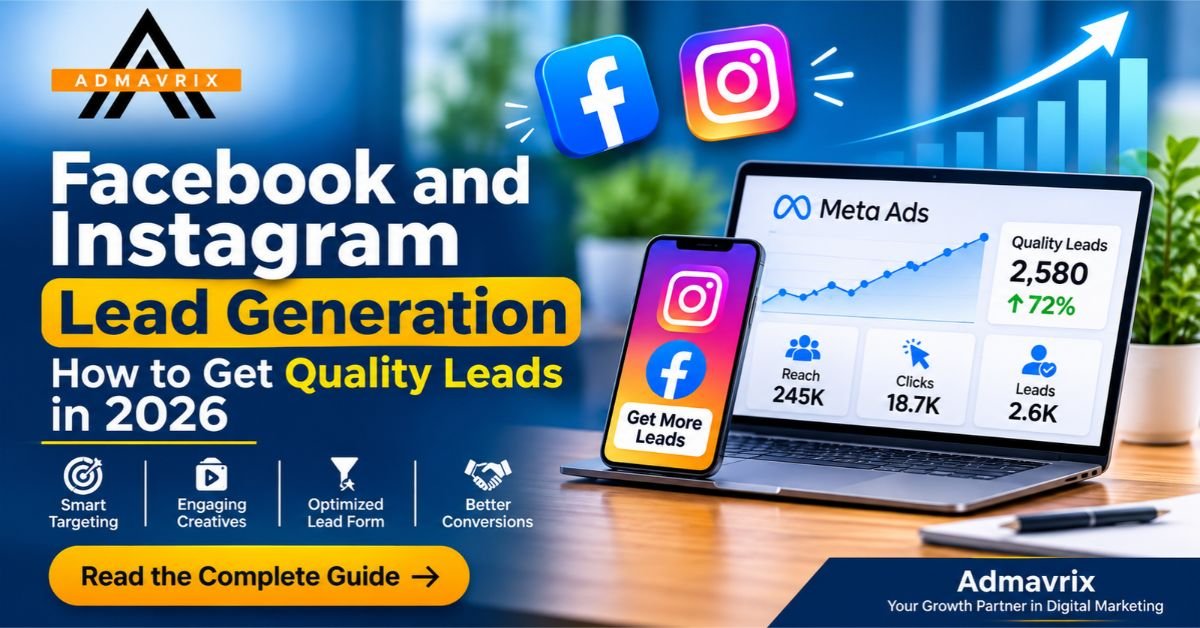
Getting Leads Is Easy. Getting Quality Leads Is the Real Challenge.
Are your Facebook and Instagram ads generating enquiries but failing to bring in actual customers?
Many businesses spend money on social media advertising but struggle to convert enquiries into sales. They receive messages, form submissions and profile visits, yet the number of genuine customers remains low.
The problem is not always the advertising budget. It could be your audience targeting, creative strategy, landing page, lead form or follow-up process.
Facebook and Instagram lead generation can help businesses connect with potential customers, build relationships and generate meaningful enquiries when campaigns are planned correctly.
In this guide, we will explain how to generate quality leads through Facebook and Instagram Ads in 2026, including targeting strategies, campaign setup, creative ideas, optimization techniques, and practical examples.
What Is Facebook and Instagram Lead Generation?
Facebook and Instagram lead generation is the process of attracting potential customers through paid social media advertisements and collecting their contact information or enquiries.
Both platforms operate within Meta’s advertising ecosystem, allowing businesses to manage campaigns through Meta Ads Manager.
Businesses can use different advertising formats to encourage potential customers to take action.
For example:
- Submit their name, phone number and email address.
- Send a direct message to the business.
- Start a WhatsApp conversation.
- Visit a landing page and complete an enquiry form.
- Request a quotation or consultation.
- Register for a course, service or event.
The objective is not simply to collect contact details. It is to attract people who are genuinely interested in the products or services being offered.
Why Are Facebook and Instagram Ads Important for Businesses?
Social media advertising provides businesses with opportunities to reach potential customers based on their interests, location, demographics and other available targeting signals.
Here are some important reasons businesses use Meta Ads for lead generation.
1. Reach a Relevant Audience
Businesses can build campaigns around specific locations, customer interests and relevant audience characteristics.
2. Generate Direct Enquiries
Potential customers can contact businesses through lead forms, Instagram Direct, Messenger or WhatsApp, depending on the campaign setup.
3. Promote Products and Services
Businesses can showcase their services through images, videos, carousels and other advertising formats.
4. Control Advertising Budgets
Advertisers can set campaign budgets, monitor spending and adjust their advertising strategy based on performance.
5. Measure Campaign Performance
Meta Ads Manager provides campaign performance information, including impressions, reach, clicks, leads and cost per result.
Key Points of a Successful Lead Generation Campaign
Before launching an advertising campaign, businesses should understand the elements that influence lead quality.
- Clear objective: Decide whether you want enquiries, registrations, bookings or consultations.
- Audience targeting: Reach people who are likely to need your product or service.
- Creative strategy: Use attention-grabbing images and videos that communicate value.
- Strong offer: Give people a genuine reason to enquire.
- Optimized lead forms: Collect the information necessary to qualify potential customers.
- Fast follow-up: Contact interested prospects promptly.
- Performance tracking: Evaluate qualified leads and conversions rather than focusing only on lead volume.
Visual Introduction: How Facebook and Instagram Lead Generation Works
A successful campaign follows a simple customer journey:
Business → Advertisement → Interested Audience → Enquiry → Follow-Up → Qualified Lead → Customer
Each stage has an important role.
- Advertisement: Introduces your product or service.
- Audience: Connects your message with potential customers.
- Enquiry: Encourages people to take action.
- Follow-up: Helps understand their requirements.
- Conversion: Turns interested prospects into paying customers.
Businesses should optimize the complete customer journey instead of focusing only on the advertisement.
Features of Facebook and Instagram Lead Generation Ads
Meta provides different advertising options to help businesses collect enquiries.
1. Instant Forms
Instant Forms allow users to submit their information without leaving Facebook or Instagram.
Businesses can collect details such as names, phone numbers, email addresses and answers to qualifying questions.
2. Click-to-WhatsApp Ads
These advertisements encourage users to start a conversation with a business through WhatsApp.
They are particularly useful for businesses that handle enquiries and bookings through messaging.
3. Instagram Direct Ads
Businesses can encourage potential customers to send direct messages to ask questions, request prices or learn more about a service.
4. Website Conversion Campaigns
Businesses can direct interested users to dedicated landing pages where they can submit enquiry forms.
5. Custom and Lookalike Audiences
Businesses can use eligible first-party customer data to create Custom Audiences and, where available, Lookalike Audiences to reach people with characteristics similar to existing customers.
Benefits of Facebook and Instagram Lead Generation
| Benefit | How it helps businesses |
|---|---|
| Audience reach | Connects with potential customers |
| Budget control | Allows flexible campaign spending |
| Lead collection | Generates enquiries through different formats |
| Visual advertising | Showcases products and services |
| Performance tracking | Helps measure campaign results |
| Retargeting | Reconnects with eligible previous audiences |
| Lead nurturing | Supports ongoing customer communication |
The biggest advantage is the ability to combine audience discovery, visual storytelling and enquiry generation within one advertising ecosystem.
Quick Insights: Important Lead Generation Metrics
Understanding campaign metrics helps businesses identify what is working and what needs improvement.
| Metric | What it tells you |
|---|---|
| Impressions | Number of times ads were displayed |
| Reach | Number of unique people who saw ads |
| CTR | Percentage of impressions that generated clicks |
| CPC | Average cost per click |
| CPL | Average cost per lead |
| Lead conversion rate | Percentage of visitors who became leads |
| Qualified lead rate | Percentage of leads matching your target customer profile |
| Customer acquisition cost | Cost of acquiring a paying customer |
Important: A lower cost per lead does not automatically mean a better campaign. A campaign generating fewer but more qualified leads may deliver better business results.
Step-by-Step Guide: How to Generate Quality Leads Through Facebook and Instagram Ads
Step 1: Define Your Target Customer
Before creating an advertisement, understand who you want to reach.
Consider:
- Age group and relevant demographics.
- Business or customer requirements.
- Geographic location.
- Interests and purchasing behaviour.
- Problems your product or service solves.
- Budget and buying intent.
For example, a pet boarding business in Gurugram should focus on relevant local pet owners rather than advertising to an audience across the entire country.
The more relevant your audience and offer, the better your chances of attracting useful enquiries.
Step 2: Choose the Right Campaign Objective
Start by identifying the action you want potential customers to take.
Depending on the available Ads Manager objectives and campaign setup, you can choose an appropriate lead-focused approach.
Common options include:
- Instant Form submissions.
- Website enquiry forms.
- WhatsApp conversations.
- Messenger enquiries.
- Instagram Direct conversations.
Choose the conversion location and optimization settings that match your business goal.
Step 3: Create an Attractive Advertisement
Your advertisement should communicate the main benefit within the first few seconds.
Use:
- High-quality images.
- Short and engaging videos.
- Clear headlines.
- Customer testimonials where genuine.
- Product demonstrations.
- Specific service benefits.
- Strong calls to action.
For example:
Instead of writing:
“Best Digital Marketing Services Available.”
Try:
“Struggling to Generate Business Leads? Let’s Build a Better Digital Marketing Strategy.”
The second message directly addresses a potential customer’s problem.
Step 4: Build a High-Converting Lead Form
A lead form should collect enough information to understand the customer’s requirements without creating unnecessary friction.
Consider collecting:
- Full name.
- Phone number.
- Email address.
- Service required.
- Location.
- Expected budget or timeline, where relevant.
For higher-intent enquiries, consider using additional qualifying questions or a review step where available.
Avoid asking too many questions that could discourage genuine prospects.
Step 5: Use the Right Landing Page
If you are directing users to your website, make sure the landing page matches the advertisement.
A good landing page should include:
- A clear headline.
- Service information.
- Main customer benefits.
- Trust signals and genuine testimonials.
- A visible enquiry form.
- A clear call to action.
- Mobile-friendly design.
Your landing page should make it easy for visitors to understand the offer and take the next step.
Step 6: Set a Suitable Advertising Budget
Start with a manageable budget and test your campaigns before increasing spending.
For example, a business could begin with ₹300–₹500 per day, depending on its market, competition and available resources.
This is an illustrative starting range, not a guaranteed budget recommendation.
Test different audiences, creatives and offers to understand which combination generates the best qualified leads.
Step 7: Track and Optimize Campaign Performance
Monitor your campaigns regularly through Meta Ads Manager.
Pay attention to:
- Cost per lead.
- Number of qualified leads.
- Click-through rate.
- Lead form completion rate.
- Frequency.
- Customer conversion rate.
- Cost per acquired customer.
Do not increase the budget simply because your campaign generates a large number of enquiries.
First, understand whether those enquiries are relevant and have genuine purchasing interest.
Step 8: Follow Up With Every Genuine Enquiry
Lead generation does not end when someone submits a form.
Create a follow-up process:
- Receive the enquiry.
- Contact the prospect.
- Understand their requirements.
- Share relevant information.
- Address questions and objections.
- Schedule a consultation or booking.
- Record the outcome.
A structured follow-up process helps businesses avoid losing interested prospects.
Small Case Study: How a Local Business Can Improve Lead Quality
Consider a hypothetical pet boarding business operating in Gurugram.
The business wants to attract pet owners looking for safe and reliable dog boarding services.
Initial campaign approach:
The business launches a general advertisement with a broad audience and a basic enquiry form.
It receives enquiries, but many people are outside its service area or are not interested in booking.
Improved campaign approach:
The business makes several changes:
- Focuses on relevant locations around Gurugram.
- Uses genuine photos and videos of its pet care facilities.
- Highlights boarding services and customer benefits.
- Adds questions about pet size, boarding dates and location.
- Uses WhatsApp or phone follow-ups to understand requirements.
- Tracks actual bookings rather than just form submissions.
Expected learning: The improved campaign may receive fewer enquiries but a higher proportion of relevant prospects.
This is why lead quality should be measured alongside cost per lead.
Deep Explanation: How to Improve Lead Quality
Generating quality leads requires more than selecting the right audience or increasing advertising expenditure.
Businesses need to optimize three important areas.
1. Audience Quality
Your advertisement should reach people who have a genuine need for your offering.
Use relevant geographic targeting, suitable audience signals and eligible first-party data.
For local businesses, location targeting is especially important.
A service provider operating in Bengaluru, for example, may not benefit from enquiries coming from customers located hundreds of kilometres away.
2. Advertisement Quality
The creative should communicate the offer clearly.
A strong advertisement generally contains:
- An attention-grabbing opening.
- A problem or requirement.
- A clear solution.
- Relevant benefits.
- A call to action.
Avoid misleading promises or exaggerated claims.
3. Lead Qualification
Not every person who submits a form is ready to purchase.
Use relevant qualifying questions to understand:
- What service they need.
- When they need it.
- Where they are located.
- Whether your offering meets their requirements.
This makes it easier for sales teams to prioritize genuine enquiries.
Real-World Example: Digital Marketing Agency Lead Generation
Imagine a digital marketing agency that wants to generate enquiries from small business owners.
Instead of promoting every service in one advertisement, the agency creates separate campaigns for:
Campaign A: SEO Services
Headline: Want More Organic Traffic From Google?
Offer: Request a Website SEO Audit.
Campaign B: Social Media Marketing
Headline: Struggling to Grow Your Business on Instagram?
Offer: Get a Social Media Strategy Consultation.
Campaign C: Paid Advertising
Headline: Spending on Ads Without Getting Quality Leads?
Offer: Request a Meta Ads Campaign Review.
Each advertisement targets a different customer requirement.
This approach helps businesses communicate more relevant messages and understand which services generate the strongest enquiries.
Facebook and Instagram Advertising Trends in 2026
Social media advertising continues to evolve. Businesses should pay attention to these important developments.
1. AI-Assisted Advertising
Meta increasingly uses AI and automation to support campaign delivery, creative optimization and audience matching.
Advertisers should provide clear creative assets and meaningful conversion signals.
2. Short-Form Video Advertising
Reels and vertical videos provide opportunities to demonstrate products, explain services and attract attention.
Businesses should experiment with authentic videos rather than relying entirely on generic promotional content.
3. First-Party Data
Customer lists, CRM information and website conversion data can help businesses understand their audiences and improve measurement, subject to consent and applicable privacy requirements.
4. Messaging-Based Lead Generation
WhatsApp and Instagram Direct can help businesses communicate with potential customers and answer questions.
5. Better Lead Qualification
Businesses are increasingly focusing on qualified leads and actual sales outcomes instead of measuring campaign success only through enquiry volume.
Common Mistakes to Avoid in Facebook and Instagram Lead Generation
Even a well-funded campaign can underperform when important elements are overlooked.
| Common mistake | Better approach |
|---|---|
| Targeting everyone | Define a relevant audience |
| Using generic creatives | Communicate specific benefits |
| Collecting too much information | Keep forms simple and relevant |
| Ignoring mobile users | Optimize the entire mobile experience |
| Not following up | Contact prospects promptly |
| Measuring only CPL | Track qualified leads and sales |
| Changing campaigns too frequently | Allow sufficient time and data for evaluation |
| Making unrealistic promises | Use honest and specific advertising claims |
| Ignoring campaign tracking | Monitor results consistently |
Pro Tips From Digital Marketing Experts
Here are practical recommendations businesses can use to improve campaign performance.
Tip 1: Test multiple creatives.
Create different versions of your advertisement with unique headlines, visuals and offers.
Tip 2: Use real customer experiences.
Authentic testimonials, demonstrations and behind-the-scenes videos can help build trust.
Tip 3: Separate campaigns by service.
Avoid combining unrelated services in a single advertisement.
Tip 4: Focus on qualified leads.
Measure whether enquiries match your ideal customer profile.
Tip 5: Improve your landing page.
A confusing landing page can reduce conversions even when the advertisement performs well.
Tip 6: Build a follow-up system.
Use a CRM or organized lead sheet to track enquiries and communication.
Tip 7: Review your campaign data.
Use actual results to decide what to pause, improve or scale.
Expert Insight
“Successful lead generation is not about collecting the highest number of contact details. It is about connecting the right audience with the right offer and creating a clear path from enquiry to conversion.”
— Admavrix Digital Marketing Insight
How Much Should Businesses Spend on Facebook and Instagram Ads?
There is no fixed advertising budget that works for every business.
Your budget depends on:
- Industry competition.
- Target location.
- Audience size.
- Service pricing.
- Advertising objectives.
- Creative quality.
- Lead conversion rate.
A small business can begin with a controlled testing budget and evaluate performance before scaling.
For example, if a business spends ₹10,000 and generates 50 enquiries, its average cost per lead is ₹200.
However, if only 5 enquiries become paying customers, the business should evaluate its cost per customer rather than assuming that ₹200 per lead represents a successful campaign.
Formula:
Cost Per Lead (CPL) = Total Advertising Spend ÷ Total Leads Generated
Cost Per Customer = Total Advertising Spend ÷ Number of New Customers
These two metrics provide a clearer picture of campaign performance.
Future Outlook: What Is Next for Meta Lead Generation?
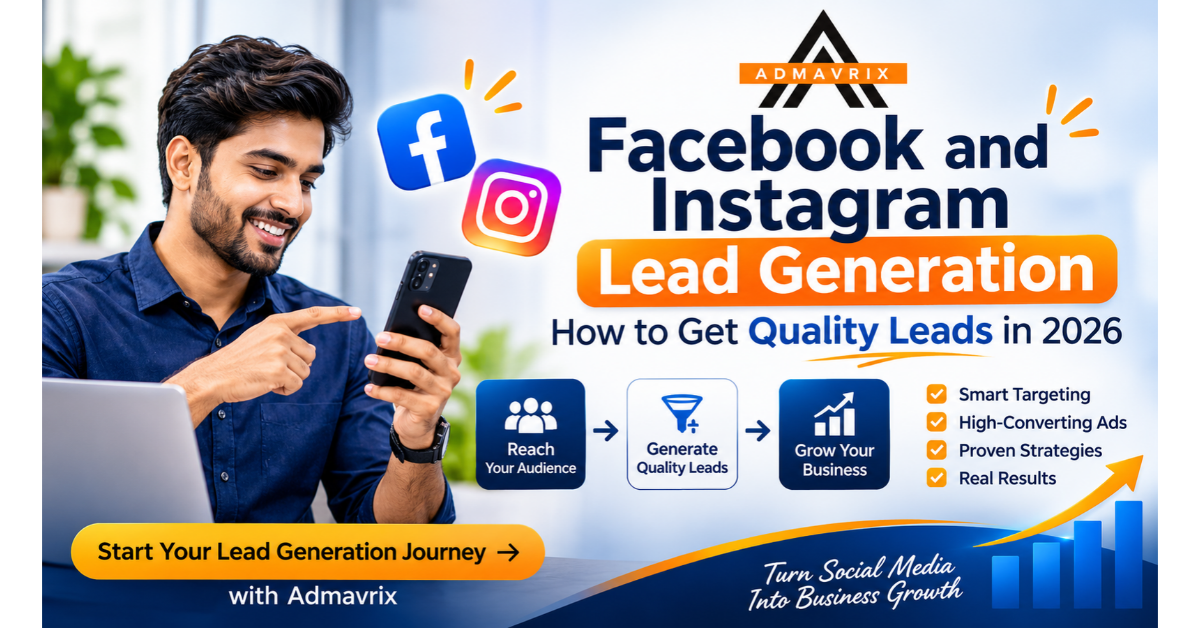
Facebook and Instagram advertising will continue evolving through AI-assisted campaign management, automated optimization, messaging experiences and improved measurement.
Businesses that combine strong creative strategies, useful offers, accurate tracking and effective follow-up processes will be better positioned to generate meaningful enquiries.
The future of lead generation is not simply about reaching more people. It is about reaching relevant audiences, understanding their requirements and building lasting customer relationships.
Businesses should also invest in their websites, landing pages and customer databases rather than depending entirely on paid advertising.
Conclusion: Turn Social Media Advertising Into Business Opportunities
Facebook and Instagram Ads can become valuable lead generation channels when businesses use the right strategy.
From audience targeting and engaging creatives to optimized lead forms and consistent follow-ups, every stage influences the quality of enquiries.
The most successful campaigns focus on attracting relevant prospects rather than collecting the highest possible number of leads.
If your business is investing in social media advertising but struggling to generate quality enquiries, it may be time to review your advertising strategy.
Need Help Generating Quality Leads for Your Business?
At Admavrix, we help businesses build digital marketing strategies focused on visibility, audience engagement and lead generation.
Whether you need SEO, social media marketing, Meta Ads or a complete digital marketing strategy, our team can help you identify opportunities to improve your online growth.
Ready to improve your lead generation strategy?
Visit: https://admavrix.com/
DM “AUDIT” to Admavrix to discuss your digital marketing requirements.
Frequently Asked Questions (FAQs)
1. How can I generate quality leads through Facebook and Instagram Ads?
Start by identifying your ideal customers, creating relevant advertisements, choosing the right campaign objective and using optimized lead forms. Follow up with enquiries promptly and measure qualified leads rather than total submissions.
2. Are Facebook Ads and Instagram Ads good for lead generation?
Yes. Both platforms offer advertising formats that help businesses collect enquiries, generate website conversions and start conversations with potential customers.
3. What is the difference between Facebook Lead Ads and Instagram Lead Ads?
Facebook Lead Ads appear on Facebook placements, while Instagram Lead Ads appear on Instagram placements. Both can support lead generation through available forms and messaging experiences.
4. How much does Facebook lead generation cost in India?
There is no fixed cost. The cost depends on industry, audience, competition, campaign objective, advertisement quality and location. Businesses should evaluate cost per qualified lead rather than relying on a universal CPL benchmark.
5. What is a good cost per lead for Facebook and Instagram Ads?
A good cost per lead depends on the value of the service, customer acquisition cost, conversion rate and profit margin. A higher-cost qualified lead may be more valuable than a cheaper, irrelevant enquiry.
6. How do I target the right audience on Meta Ads?
Define your ideal customer, choose relevant locations and use suitable audience signals. Test different audience approaches and evaluate the quality of the enquiries generated.
7. Are Instagram Reels effective for lead generation?
Reels can help businesses attract attention through short-form video content. They can support lead generation when paired with a relevant offer, clear message and suitable conversion destination.
8. Which is better for lead generation: Instant Forms or WhatsApp Ads?
Instant Forms are useful for collecting structured contact details. WhatsApp Ads are useful when customers prefer conversations before making a decision. The better option depends on your business and follow-up process.
9. How can I reduce the cost of Facebook and Instagram leads?
Improve creative quality, audience relevance, offer clarity and landing page experience. Test different approaches and optimize based on qualified lead performance.
10. How long does it take to generate leads through Meta Ads?
Campaigns can begin generating enquiries shortly after launch, but reliable performance evaluation requires sufficient delivery and conversion data. Results vary by industry, budget, competition and campaign setup.
11. Can small businesses use Facebook and Instagram Ads?
Yes. Small businesses can start with manageable budgets, focus on relevant audiences and test different advertising formats before increasing spending.
12. How do I know whether my Facebook and Instagram Ads are successful?
Track qualified leads, cost per lead, customer conversion rate and customer acquisition cost. Ultimately, the number of genuine customers and business value generated are more important than impressions alone.