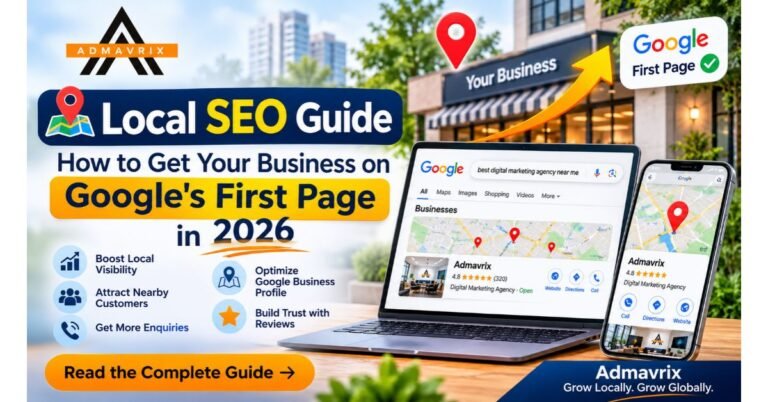
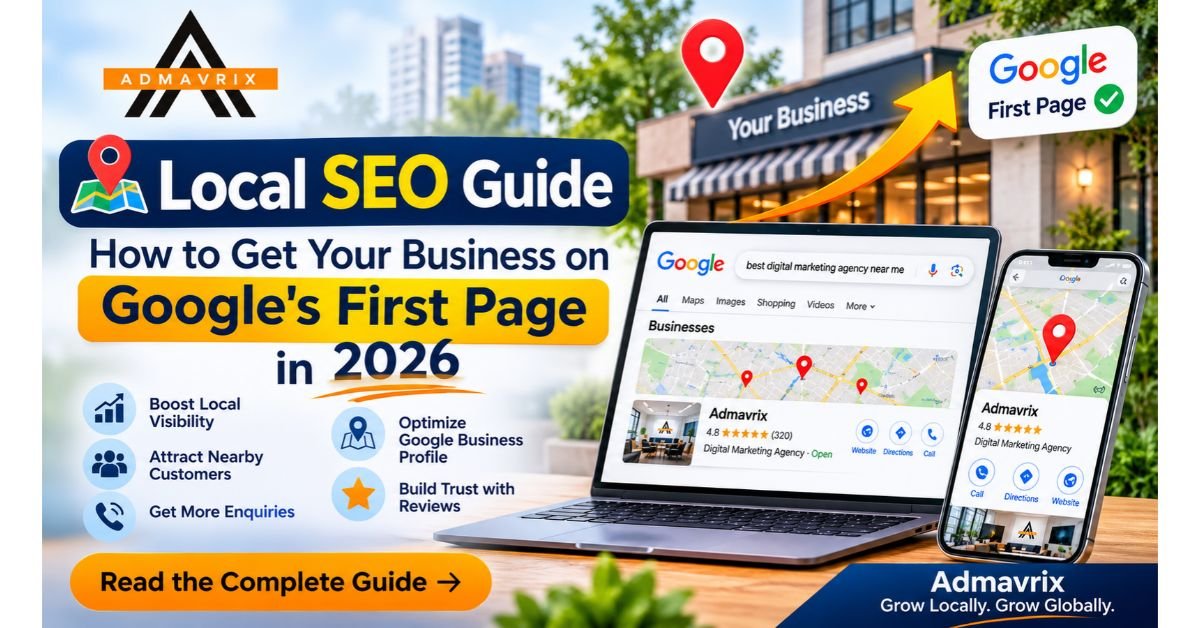
Is Your Business Invisible When Local Customers Search on Google?
Imagine someone searching for “best digital marketing agency near me”, “dentist in Bengaluru” or “plumber near me”.
Google displays relevant businesses, websites and Google Maps listings. Customers explore the available options and contact businesses that appear useful and trustworthy.
But what happens if your business does not appear in those results?
You could be missing valuable opportunities to attract nearby customers, generate enquiries and increase sales.
This is where Local SEO becomes important.
Local SEO helps businesses improve their visibility in location-based Google searches and Google Maps. Whether you own a small shop, restaurant, clinic, agency or service business, a well-planned local SEO strategy can help potential customers discover your business.
In this complete Local SEO guide for 2026, you will learn how local search rankings work, how to optimize your Google Business Profile, how to use local keywords, how to attract genuine customer reviews and how to improve your website’s visibility in local search results.
Introduction: Why Local SEO Matters for Businesses in 2026
Today, customers frequently use search engines to find nearby products, services and businesses.
Instead of asking multiple people for recommendations, they can search Google to compare business locations, services, customer reviews, contact details and operating hours.
For businesses, this creates an opportunity to connect with customers who are already looking for what they offer.
However, having a website alone does not guarantee visibility in local search results.
Businesses need to provide accurate information, create relevant website content, optimize their Google Business Profile and establish a trustworthy online presence.
A strong local SEO strategy helps businesses:
- Improve visibility in location-based searches.
- Appear in relevant Google Maps results.
- Attract potential customers from nearby areas.
- Generate website visits, phone calls and enquiries.
- Build trust through customer reviews.
- Increase opportunities for local sales and bookings.
The goal of Local SEO is simple: Help the right customers discover your business when they search for the products or services you provide in your area.
What Is Local SEO?
Local SEO (Local Search Engine Optimization) is the process of improving a business’s online visibility for searches connected to a specific geographic location.
It helps search engines understand:
- What your business offers.
- Where your business operates.
- Which products or services you provide.
- Which locations you serve.
- Whether your business is relevant to a customer’s search.
For example, imagine you operate a digital marketing agency in Bengaluru.
When someone searches for “digital marketing agency in Bengaluru”, Google may display relevant local business listings, Maps results and organic website pages.
Local SEO helps your business become more relevant to these searches.
Local SEO vs Traditional SEO
| Factor | Local SEO | Traditional SEO |
|---|---|---|
| Main objective | Attract local customers | Attract broader audiences |
| Target audience | Customers in specific locations | Users across different locations |
| Main platform | Google Search and Maps | Google Search |
| Important optimization | Google Business Profile | Website content and technical SEO |
| Keywords | Service + location | General search keywords |
| Business goal | Local enquiries and visits | Website traffic and conversions |
Both approaches are valuable. Businesses that serve specific geographic markets should consider combining local SEO with traditional website SEO.
Key Points of Local SEO
Before implementing a local SEO strategy, understand these important elements:
- Google Business Profile: Create and optimize your business listing.
- Local keyword research: Identify the phrases customers use to find nearby services.
- Website optimization: Create useful service and location pages.
- Customer reviews: Encourage genuine feedback and respond professionally.
- Business information consistency: Keep your name, address and phone details accurate.
- Local backlinks: Build relationships with relevant local websites and organizations.
- Mobile optimization: Make your website easy to use on smartphones.
- Performance tracking: Monitor rankings, website visits, calls and enquiries.
These elements work together to strengthen your local online presence.
Visual Introduction: How Local SEO Works
Think of Local SEO as a journey that connects your business with nearby customers.
Customer Searches on Google
↓
Google Understands the Search Intent
↓
Relevant Local Businesses and Websites Appear
↓
Customer Compares Business Information and Reviews
↓
Customer Visits the Website, Calls or Requests Directions
↓
Business Gets an Opportunity to Convert the Customer
Every stage matters. A business may appear in search results, but incomplete information, poor reviews or a confusing website can prevent customers from taking action.
How Google Determines Local Search Rankings
One of the most important things to understand is how Google evaluates local search results.
According to Google’s official Business Profile guidance, local results are primarily influenced by three factors:
1. Relevance
Relevance refers to how well a business matches what a customer is searching for.
For example, if someone searches for “pet grooming services in Bengaluru”, Google tries to identify businesses that provide relevant pet grooming services.
How to improve relevance:
- Choose the most appropriate business category.
- Complete your business profile.
- Add accurate service information.
- Describe your products and services clearly.
- Create relevant website pages.
2. Distance
Distance refers to how far a business is from the person performing the search.
For example, if a customer searches for a restaurant nearby, Google considers the customer’s location and the distance to relevant businesses.
Distance is not something businesses can manipulate through ordinary SEO work. Always provide accurate location and service-area information.
3. Prominence
Prominence refers to how well-known a business is.
Google may consider information such as links from other websites, reviews and other signals of business recognition.
How to improve prominence:
- Earn genuine customer reviews.
- Build relevant local backlinks.
- Maintain an active and accurate online presence.
- Publish useful website content.
- Build relationships with local organizations.
Important: Google does not offer a guaranteed way to purchase or request better local rankings. Businesses should focus on improving their actual relevance, prominence and customer experience.
Features of Local SEO
Local SEO involves several important optimization activities.
1. Google Business Profile Optimization
Google Business Profile allows eligible businesses to manage how they appear on Google Search and Google Maps.
Businesses can provide:
- Business name.
- Business category.
- Address or service area.
- Contact information.
- Operating hours.
- Website link.
- Photos and videos.
- Products and services.
- Customer reviews.
2. Local Keyword Optimization
Local keyword optimization involves using relevant location-based search phrases naturally in your website content.
Examples:
- Digital marketing agency in Bengaluru.
- Best interior designers in Hyderabad.
- Dental clinic in Chennai.
- Web design company in Gurugram.
- AC repair services in Mumbai.
3. Local Business Citations
Citations are online mentions of your business information, such as its name, address and phone number.
These can appear on relevant business directories, industry websites and local platforms.
4. Location-Based Landing Pages
Businesses serving multiple areas can create useful location-specific website pages.
For example:
- Digital Marketing Services in Bengaluru.
- Digital Marketing Services in Hyderabad.
- Digital Marketing Services in Chennai.
Each page should contain genuinely useful and unique information. Avoid creating multiple pages that only replace the city name while repeating identical content.
5. Review Management
Customer reviews help potential customers understand other people’s experiences with your business.
Businesses should encourage genuine feedback, monitor reviews and respond professionally.
Benefits of Local SEO for Small Businesses
Local SEO can provide several long-term benefits.
| Benefit | Business advantage |
|---|---|
| Better local visibility | More opportunities to be discovered |
| Google Maps presence | Easier business discovery |
| Relevant website traffic | Attracts location-based visitors |
| Customer trust | Reviews provide useful social proof |
| More enquiries | Supports calls and contact requests |
| Long-term visibility | Builds organic search presence |
| Competitive advantage | Helps businesses compete locally |
Why Small Businesses Should Invest in Local SEO
Small businesses often compete with larger companies that have bigger marketing budgets.
Local SEO provides an opportunity to focus on a specific geographic market and relevant customer requirements.
For example, a small dental clinic in Bengaluru does not necessarily need to attract visitors from every Indian city.
It needs to become visible to people searching for dental services in the areas it actually serves.
This focused approach can make local search optimization a valuable part of a small business marketing strategy.
Quick Insights: Local SEO Optimization Checklist
| SEO activity | Recommended action | Priority |
|---|---|---|
| Google Business Profile | Complete and verify information | High |
| Business category | Select accurate categories | High |
| Local keywords | Research service + location terms | High |
| Website SEO | Optimize titles and headings | High |
| Customer reviews | Encourage genuine feedback | High |
| Mobile experience | Improve usability and speed | High |
| Local backlinks | Build relevant relationships | Medium |
| Business citations | Maintain accurate listings | Medium |
| Local content | Publish useful location-based blogs | Medium |
| SEO tracking | Monitor performance monthly | High |
Step-by-Step Guide: How to Improve Local SEO in 2026
Here is a practical local SEO strategy that businesses can follow.
Step 1: Create and Verify Your Google Business Profile
Start by visiting:
Sign in using the appropriate Google account and follow the steps to add or claim your business.
Provide accurate information, including:
- Official business name.
- Correct business category.
- Business address, if customers can visit your location.
- Service areas, if you operate as a service-area business.
- Phone number.
- Website.
- Business hours.
Complete Google’s verification process.
Pro Tip: Use your real business details. Do not create fake addresses or additional business locations to target more keywords.
Step 2: Optimize Your Google Business Profile
After verification, review every section of your profile.
Make sure your business information is complete and accurate.
Important optimization activities include:
- Select the most relevant primary category.
- Add appropriate additional categories.
- Describe your services accurately.
- Upload genuine business photos.
- Add relevant products or services.
- Update operating hours.
- Maintain current contact information.
- Add your official website.
Use natural business descriptions rather than repeating the same keywords unnecessarily.
Step 3: Find the Right Local SEO Keywords
Keyword research helps you understand what potential customers search for.
Start with your main services and combine them with the locations you serve.
For example, a digital marketing agency can target:
| Service | Local keyword example |
|---|---|
| SEO | SEO services in Bengaluru |
| Social media | Social media marketing agency in Bengaluru |
| Web design | Website development company in Bengaluru |
| Paid advertising | Google Ads agency in Bengaluru |
| Digital marketing | Digital marketing agency near me |
Useful keyword research tools include:
- Google Keyword Planner.
- Google Trends.
- Google Search autocomplete.
- Google Search Console.
- Google Business Profile performance data.
- Semrush.
- Ahrefs.
Look for keywords that reflect actual customer requirements rather than choosing phrases only because they sound popular.
Step 4: Optimize Your Website for Local Searches
Your website should clearly explain what your business offers and which locations you serve.
Important website SEO elements include:
SEO Title: Include the primary service and location naturally.
Example: Digital Marketing Agency in Bengaluru | Admavrix
Meta Description: Write a clear description explaining your services and geographic coverage.
H1 Heading: Use one clear main heading that describes the page.
H2 Headings: Organize services, benefits, processes and frequently asked questions.
URL: Use short and descriptive URLs.
Example: /digital-marketing-agency-bengaluru/
Image Alt Text: Describe the actual image accurately.
Internal Links: Link relevant blog articles to your service pages.
Step 5: Create Dedicated Location Pages
If your business genuinely serves multiple locations, create useful pages for those locations.
For example, a business serving customers in Bengaluru, Hyderabad and Chennai can create separate pages explaining:
- Available services.
- Areas covered.
- Customer requirements.
- Relevant projects or experience.
- Contact and enquiry options.
Do not create doorway pages designed only to capture keyword variations without providing unique value.
Step 6: Collect Genuine Customer Reviews
Reviews can improve customer confidence and contribute to your business’s prominence.
Ask customers who have genuinely used your products or services to share their experiences.
You can request reviews through:
- Follow-up emails.
- WhatsApp messages.
- QR codes at your business location.
- Post-purchase communication.
- Direct review links.
Always follow Google’s review policies.
Do not purchase fake reviews, offer rewards for positive ratings or selectively request only positive feedback.
Step 7: Build Local Backlinks and Citations
Backlinks from relevant websites can help strengthen your website’s authority and discoverability.
Consider opportunities such as:
- Local business associations.
- Industry publications.
- Relevant business directories.
- Local event websites.
- Community partnerships.
- Genuine business collaborations.
- Local media coverage.
Focus on relevance and trust rather than collecting hundreds of low-quality links.
Step 8: Improve Mobile Website Experience
Many customers use smartphones to search for nearby businesses.
Your website should:
- Load efficiently.
- Display correctly on mobile screens.
- Use readable fonts.
- Have clear navigation.
- Provide visible contact information.
- Make enquiry forms easy to complete.
- Include accessible call and contact options.
A mobile-friendly website helps customers take action after discovering your business.
Step 9: Add Relevant Local Business Structured Data
Structured data helps search engines understand certain information about your business.
Eligible businesses can implement appropriate LocalBusiness structured data using Schema.org vocabulary.
Depending on the business type, relevant details may include:
- Business name.
- Address.
- Telephone number.
- Website.
- Opening hours.
- Geographic information.
- Business type.
Ensure that structured data accurately reflects information visible on your website.
You can test your implementation using Google’s Rich Results Test and Schema Markup Validator.
Important: Structured data does not guarantee a special search appearance or higher ranking.
Step 10: Track Your Local SEO Performance
SEO improvements should be measured regularly.
Use Google Search Console to monitor:
- Search queries.
- Clicks.
- Impressions.
- Average position.
- Page performance.
- Indexing issues.
Use Google Analytics 4 to understand:
- Organic traffic.
- Landing page performance.
- User engagement.
- Enquiry conversions.
- Traffic sources.
Also monitor Google Business Profile performance, including available searches, calls, website clicks and direction requests.
Review these metrics every month and identify areas that need improvement.
Small Case Study: How a Local Business Can Improve Its Google Visibility
Example: A Dental Clinic in Bengaluru
Consider a hypothetical dental clinic operating in Bengaluru.
The clinic has a website but receives very few enquiries from organic search.
Its Google Business Profile contains limited information, and its website does not clearly explain the treatments available.
Initial challenges
- Incomplete business information.
- Limited customer reviews.
- No dedicated treatment pages.
- Poor local keyword targeting.
- Weak mobile website experience.
SEO improvements
The clinic implements a local SEO strategy:
- Completes and verifies its Google Business Profile.
- Updates its primary business category and services.
- Adds genuine clinic photographs.
- Creates useful pages for dental treatments.
- Optimizes relevant pages for Bengaluru location searches.
- Encourages genuine patient reviews.
- Improves mobile website usability.
- Tracks organic enquiries and search performance.
Expected outcome
Over time, these improvements can help the clinic build a stronger local online presence and create more opportunities to attract relevant customers.
Important: This is an illustrative example, not a verified client result or a promise of specific rankings or traffic growth.
Real-World Example: Local SEO for a Digital Marketing Agency
Imagine a digital marketing agency operating in Bengaluru.
The agency wants to attract small business owners searching for SEO and social media marketing services.
Instead of targeting only broad keywords such as “digital marketing”, the agency develops a more focused strategy.
Target keywords:
- Digital marketing agency in Bengaluru.
- SEO services in Bengaluru.
- Social media marketing agency in Bengaluru.
- Google Ads management services.
- Website SEO services for small businesses.
Website improvements:
- Creates a dedicated digital marketing services page.
- Explains its SEO and advertising services.
- Publishes educational marketing blogs.
- Adds relevant client examples and genuine testimonials.
- Includes clear enquiry forms.
- Links educational articles to relevant service pages.
Google Business Profile improvements:
- Uses accurate business information.
- Selects relevant categories.
- Adds genuine business images.
- Maintains updated services and operating hours.
- Responds to customer reviews.
The combination of website optimization, local relevance and customer trust can create stronger opportunities for local search visibility.
Local SEO Trends to Watch in 2026
Local search continues to evolve as Google improves how it understands search intent, business information and customer needs.
Here are some important areas businesses should focus on.
1. AI-Powered Search Experiences
Search engines increasingly use AI to understand complex queries and provide relevant information.
Businesses should publish useful, accurate and well-structured content that clearly explains their services and expertise.
2. Google Maps and Local Discovery
Google Maps remains an important way for customers to discover nearby businesses.
Accurate business information, relevant categories, photos and reviews help customers evaluate local options.
3. Conversational and Voice Searches
Customers may use natural language when searching for services.
Examples:
- Where can I find a good dentist near me?
- Which digital marketing agency offers SEO services in Bengaluru?
- Find a pet grooming service nearby.
Businesses should create clear website content that answers genuine customer questions.
4. Customer Reviews and Reputation
Customers increasingly compare businesses before making purchasing decisions.
Consistent review management and genuine customer feedback can strengthen trust.
5. Mobile-First Local Discovery
Mobile usability remains essential because customers often search for businesses while travelling or looking for immediate services.
6. First-Party Business Information
Accurate information on your website and Business Profile helps customers understand your services, location, contact details and availability.
Businesses should regularly review and update this information.
Common Local SEO Mistakes Businesses Should Avoid
Many businesses struggle with local visibility because they make avoidable optimization mistakes.
| Common mistake | Better solution |
|---|---|
| Incomplete Google Business Profile | Complete accurate business details |
| Wrong business category | Select the most relevant category |
| Keyword stuffing | Use natural and relevant keywords |
| Fake customer reviews | Encourage genuine customer feedback |
| Duplicate business listings | Follow Google’s listing guidelines |
| Fake business addresses | Use legitimate business locations |
| No local website content | Create useful location-specific pages |
| Poor mobile experience | Optimize mobile usability |
| Ignoring customer reviews | Respond professionally |
| Buying low-quality backlinks | Build relevant, trustworthy links |
| No performance tracking | Monitor Search Console and Analytics |
Avoiding these mistakes helps businesses build a more reliable local SEO foundation.
Pro Tips: How to Improve Your Local SEO Strategy
Here are additional recommendations to strengthen your local search presence.
Tip 1: Focus on one main location first.
Optimize your primary business location and service pages before expanding to other geographic areas.
Tip 2: Use natural location keywords.
Include relevant location names in titles, headings and website content where they genuinely make sense.
Tip 3: Publish helpful local content.
Create articles that answer questions your potential customers ask.
Tip 4: Keep business information consistent.
Make sure your business name, address and contact information are accurate across your website and important listings.
Tip 5: Add genuine photographs.
Show your real business location, products, staff, services and customer experiences where appropriate.
Tip 6: Respond to reviews.
Thank customers for their feedback and address concerns professionally.
Tip 7: Strengthen internal linking.
Connect educational blog posts to relevant service pages using descriptive anchor text.
Tip 8: Measure actual enquiries.
Track calls, forms, bookings and sales instead of focusing only on website traffic.
Tip 9: Keep your website updated.
Review outdated business details, broken links, service information and important landing pages.
Tip 10: Be patient and consistent.
Local SEO is an ongoing process. Rankings and visibility can take time to improve, and results depend on competition, location and business relevance.
Expert Insight: What Google Says About Local Rankings
Google identifies three primary factors for local search rankings:
- Relevance.
- Distance.
- Prominence.
Google also explains that businesses cannot pay or request a better local ranking through its Business Profile system.
This means businesses should focus on providing complete information, maintaining a trustworthy online presence and building genuine recognition rather than looking for ranking shortcuts.
Admavrix Expert Insight:
“The strongest local SEO strategy connects accurate business information, helpful website content and genuine customer trust. Instead of chasing rankings alone, businesses should make it easier for nearby customers to discover, understand and contact them.”
— Admavrix Digital Marketing Team
Future Outlook: What Is Next for Local SEO?
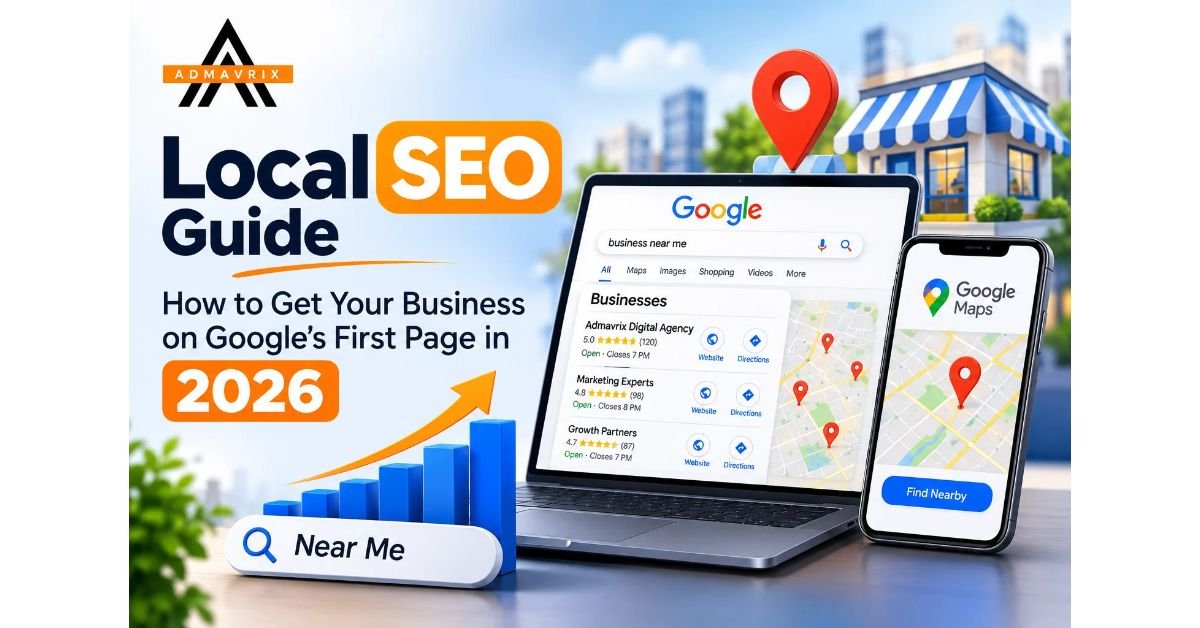
Local SEO will continue to play an important role in how businesses connect with nearby customers.
As search experiences become more conversational and AI-assisted, businesses will need to provide clear, accurate and useful information across their websites and business profiles.
Future local SEO strategies should focus on:
- Stronger business information accuracy.
- Helpful and original website content.
- Genuine customer reviews.
- Better mobile experiences.
- Relevant local backlinks.
- Useful location-based service pages.
- Clear business identity and expertise.
- Conversion tracking and customer experience.
Businesses that consistently improve these areas can build a stronger foundation for long-term organic visibility.
The key is to focus on customer needs rather than trying to manipulate search rankings.
Conclusion: Make Your Business Easier to Find on Google
Getting your business on Google’s first page requires a consistent and well-planned SEO strategy.
Local SEO helps businesses improve their visibility in location-based searches, strengthen their Google Business Profile, attract relevant website visitors and create more opportunities to generate enquiries.
From keyword research and website optimization to genuine reviews and local backlinks, every activity contributes to building a stronger online presence.
Remember, there is no guaranteed shortcut to the first page of Google. The most sustainable approach is to provide accurate business information, useful content and a trustworthy customer experience.
Whether you run a small business, professional service, restaurant, clinic or digital agency, investing in Local SEO can help you connect with customers searching for your services in your area.
Want to Improve Your Business Visibility on Google?
At Admavrix, we help businesses strengthen their online presence through SEO, digital marketing, social media marketing and paid advertising strategies.
Our goal is to help businesses improve search visibility, attract relevant audiences and create meaningful growth opportunities.
Whether you need a Local SEO strategy, Google Business Profile optimization or a complete digital marketing plan, Admavrix can help you identify the right opportunities.
Ready to improve your local search visibility?
Visit: https://admavrix.com/
DM “AUDIT” to Admavrix and discuss your website’s SEO opportunities.
Frequently Asked Questions About Local SEO
1. What is Local SEO in simple words?
Local SEO is the process of improving your business’s visibility in Google Search and Google Maps when people search for products or services in a specific location.
2. How can I get my business on Google’s first page?
Optimize your Google Business Profile, research relevant keywords, improve your website content, earn genuine reviews, build relevant backlinks and maintain accurate business information. Rankings depend on several factors, and no strategy can guarantee first-page placement.
3. Is Google Business Profile important for Local SEO?
Yes. Google Business Profile is an important tool for managing how eligible businesses appear on Google Search and Maps. Complete and accurate information helps Google understand your business.
4. How long does Local SEO take to show results?
Local SEO timelines vary depending on competition, location, website quality, business prominence and existing online presence. Some improvements may become visible sooner, while stronger results can take several months.
5. Is Local SEO useful for small businesses?
Yes. Local SEO can help small businesses connect with customers searching for nearby products and services. It is particularly useful for restaurants, clinics, shops, agencies and service providers.
6. What are the three main factors of local search ranking?
Google identifies relevance, distance and prominence as the three primary factors influencing local results.
7. What is the difference between Local SEO and Google Maps SEO?
Google Maps SEO generally refers to improving a business’s visibility on Google Maps. Local SEO is broader and includes Google Maps, local organic search results, website optimization and local online presence.
8. How do I find local SEO keywords?
Use Google Keyword Planner, Google Search autocomplete, Google Trends and Google Search Console. Combine relevant service terms with the locations your business genuinely serves.
9. Do customer reviews help Local SEO?
Reviews help potential customers evaluate businesses. Google also identifies review quantity and positive ratings as factors that can contribute to prominence in local rankings.
10. Can I do Local SEO without a website?
Yes. An eligible business can manage a Google Business Profile without having its own website. However, a useful website provides additional opportunities to explain services, publish content and generate enquiries.
11. What are local citations in SEO?
Local citations are online mentions of your business details, such as business name, address and phone number. They may appear on directories, industry websites and local platforms.
12. What is the best tool for Local SEO?
Useful tools include Google Business Profile, Google Search Console, Google Analytics 4, Google Keyword Planner, Google Trends, Semrush and Ahrefs. The right combination depends on your business and budget.
13. Does posting on Google Business Profile improve rankings?
Regularly sharing useful updates can help customers understand your business and stay informed. However, posting frequency alone is not a guaranteed local ranking factor.
14. Can a business rank in multiple cities with Local SEO?
A business can target multiple locations when it genuinely serves those areas. Create useful location-specific website content and provide accurate business information. Do not create fake addresses or misleading listings.
15. What is the best Local SEO strategy for 2026?
Focus on an accurate Google Business Profile, relevant local keywords, useful website content, genuine customer reviews, relevant backlinks, mobile usability and consistent performance tracking.